
The Healing Innovator—How Lisa F. Crites Turned Personal Devastation Into a Global Movement for Patient Dignity
By The Enterprise Insight She never planned to become an inventor, like not even a little. Lisa F. Crites spent decades as a journalist trained to watch, to question, and to tell other people’s stories with a kind of careful precision and a steadiness, maybe compassion. She basically built a career on bearing witness to both suffering and resilience, never thinking that one day she would end up being the very person described, the “subject,” instead of the observer. But life, as it often does, had other ideas. On the far side of a devastating cancer diagnosis and then the sudden, shattering loss of her mother, Crites found herself in a hospital room—not as a reporter with a notepad, but as a patient, stripped of her identity, her agency, and, most painfully, her dignity. The humiliations of recovery kept coming, relentless, almost like a drumbeat. Yet it was one small, humiliating moment being handed a plastic trash bag so she could cover her wounds and then shower; that was kind of the spark. That tiny insult, that stubborn refusal to accept that healing should cost humanity, lit something up, and it didn’t just fade. What came out of that hospital bed wasn’t only a product; it felt like a movement. The Shower Shirt™, her patented medical garment, has since crossed borders and oceans, reaching patients in over twenty countries. It’s proof that happens when one person decides not to accept what’s unacceptable. And her story, told in the Amazon Best Selling Memoir Beautifully Unbroken, has reshaped her from survivor into a beacon of hope and a serious, formidable voice for patient-centered innovation. Published on May 29, 2026, Beautifully Unbroken has consistently ranked in the Top 10 for Amazon Best Sellers in New Releases, trending in categories such as Spiritual Biography, Cancer, and Health and Spirituality, while earning a remarkable 4.9 out of 5-star rating from readers. The book has received critical acclaim, with the International Impact Book Awards naming Crites a Distinguished Author—an honor reserved for those “whose stories leave the world better than they found it”—and she has been invited to the 2027 International Impact Book Awards Honors & Gala in Arizona. Adding to its impact, $1 from each copy sold is donated to breast cancer support groups and nonprofit organizations serving breast cancer patients. Today, Lisa F. Crites sort of stands at the intersection of empathy and engineering, journalism and invention, and faith and action. She is not just a leader in healthcare, she is a new kind of leader, who shows that the most profound solutions get born not in boardrooms or laboratories, but in the raw, unflinching honesty of human experience. In an industry that can be paralyzed by complexity, she brings this simple radical plan , listening to the patient. See the person. And never ever accept a trash bag as an answer. This is her story and also the outline for a more compassionate future. The Moment That Changed Everything In the spring of 2009, Lisa Crites got a breast cancer diagnosis that would, you know, change everything about her life. The news didn’t show up quietly either; it came right after another blow that felt brutal: her mother died suddenly. So there she was, in the middle of grief and fear, facing a bilateral mastectomy and then a recovery that was honestly grueling. But it wasn’t only the diagnosis that would shape her whole path. It was what happened afterward, during the days nobody talks about. Crites came home from surgery with surgical drains, and she was told—very specifically—to keep them dry while showering. Her surgeon was, how do you say, completely strict: no water could touch the drain sites because of infection risk. And the “Answer,” she got, was not, um, something gentle. The suggestion was a plastic trash bag. Cut openings for the head and arms, then wear it like a kind of awkward garment. For a medical journalist who had spent decades covering healthcare, this wasn’t just an inconvenience. It felt like an insult. “I was determined to create a solution that helped breast cancer patients get through recovery easier than I did,” she later said. “A trash bag is not a solution for women to shower in after mastectomy surgery.” That little spark of outrage turned into more than frustration. It became the seed of an actual mission, something bigger than a product, and it grew from there. From Trash Bag To Medical Device: The Invention Story What started out as personal frustration sort of spiraled into a strict and almost relentless routine of research, design, and testing. Crites approached it with the same focus and discipline she had used as a broadcast reporter, not really surprised. She looked into patient needs pretty deeply, then talked with medical professionals as expert references, and adjusted the product design using what happened in real life. Her brother, who is an architect and structural engineer, lent a hand with the design and the sketches too. Her aunt and cousin actually put together the first prototype, bit by bit, in a hands-on way. And then there it was, The Shower Shirt™ : a water-resistant garment made of parachute material on the outside and microfiber on the inside, with a water-resistant zipper, Velcro closure, elastic openings for the neck and arms, built-in compartments for surgical drains, and straps that help secure tubing on each side. The product got its patent in 2011, and it showed up in the U.S. market that very same year. Today, it’s classified as a Class I Medical Device, and it’s sold in hospitals, mastectomy boutiques, and major retailers such as Amazon and Walmart. Crites is part of a small circle of women inventors in the United States, where only 2.7% of women own individual patents like hers. There was no research-and-development team behind her, and no academic funding or institutional resources either. It was truly just one person, using focus, determination, resilience, and grit to turn a medical
The Photonic Prophet—How an Artist-Turned-Scientist Is Bending Light to Save the Future of AI
Before Dr. Ko-Cheng Fang was a scientist, he was an artist. Growing up surrounded by sculptures, paintings, and art literature, he developed an extraordinary visual memory and a kind of philosophy where creativity and logic are complementary forces. That artistic discipline—training him to notice details and approach problems with imagination, not just solve them fast—would later become absolutely essential in his scientific work. Today, he stands at the forefront of the photonic revolution and, in a way, bridges art, science, and technology like nobody else has managed before. That artistic grounding now shows up in breakthroughs that feel like they defy physics itself. In 2025, Fang unveiled a 2-nanometer X-Photon material capable of confining light and bending it at ninety degrees—something physics declared impossible. For the founder, chairman, and CEO of LongServing Technology, bending light was just the beginning. Between that impossible turn and the promise of a thousandfold leap in computing power lies a journey spanning over two decades—from cybersecurity pioneer to photonics visionary, from U.S. Department of Homeland Security collaborator to the man international media now calls the “Godfather of Photonics.” The stakes could not be higher. Our insatiable hunger for AI is colliding with the physical limits of silicon. Power grids are buckling. Cooling systems are failing. The “memory wall”—where processors are starved for data by the bottlenecks of copper wiring and electron flow—threatens to halt technological progress. Dr. Fang has spent years developing the solution in relative obscurity. Now, his proprietary X-Photon material and Photonic Memory (PFLASH) architecture are poised to reshape the future of computing, delivering thousandfold speed with ninety percent less energy consumption. This is the story of how an artist who became a scientist bent light—and in doing so, may just save humanity from itself. From Cybersecurity to Photonics—A Journey of Vision Dr. Fang’s journey to the bleeding edge of photonics did not begin in a semiconductor lab. It began, in a way, with art. “Before I was a scientist, I was an artist,” he reflects, kind of like it was obvious. Growing up among sculptures, paintings, and art literature, he built an unusual visual memory and a kind of philosophy where creativity and logic are not really clashing things but instead matching complementary forms of the same curiosity. That artistic discipline—it trained him to notice the small details and to approach problems with imagination, maybe a little stubbornly—later became crucial in his scientific work. His technological journey formally began in the realm of cybersecurity. Over two decades ago, long before the widespread adoption of smartphones, Dr. Fang proactively developed core technologies such as smart passcode locks and cloud storage, anticipating the vulnerabilities of a connected future. His early patents, including U.S. Patent US 8060933B2, were so foundational that they led to collaboration with the U.S. Department of Homeland Security on decryption and cybersecurity protocols. For years, these inventions were held under strict national security confidentiality orders, a period of enforced silence that Dr. Fang describes as a “setback and self-exile.” “I don’t focus on tomorrow; I only look back to see if today is better than yesterday,” he quotes, reflecting a philosophy forged by early challenges. “No matter how long the journey ahead, as long as I never give up, success is guaranteed.” This resilience was tested when he pivoted to tackle what he saw as the single greatest technological challenge of our era: the physical limits of silicon. Breaking The “Memory Wall”—The Photonic Revolution The explosion of generative AI and large language models has created a paradox. While software grows exponentially more powerful, the hardware powering it—traditional electronic chips—is hitting hard physical barriers in speed, thermal management, and energy consumption. The industry calls it the “memory wall,” where processors are starved for data by the bottlenecks of copper wiring and electron flow. Dr. Fang identified this problem years ago and has been developing the solution in relative obscurity until now. “A large-scale cloud computing center requires an enormous memory array,” he explains. “Since photonic computing power exceeds that of electronics by at least one thousand times, a single photonic computing center is equivalent to one thousand electronic computing centers.” The breakthrough lies in his development of photonic memory, or PFLASH. Unlike conventional systems that constantly convert light to electricity and back again, creating massive energy loss and heat, photonic memory enables the direct storage and transmission of photonic signals. Dr. Fang achieved this through a principle of photochemical energy temporary storage, fabricated into what he calls a “photon capacitance.” Imagine a glow stick that provides illumination without generating heat—that is the basic concept, scaled to a 3D architecture featuring seven laser apertures. Paired with his X-Photon material, which replaces copper interconnects with optical pathways, the architecture delivers a seismic shift in capability. Traditional silicon chips, even at 2 nanometers, still rely on transistors and copper wiring that are physically larger than the chip’s optical pathways. Dr. Fang’s photonic chips, by contrast, feature a 2-nanometer optical path and photonic gate, eliminating leakage currents and enabling multi-bit (decimal) calculations rather than the binary on/off switching of electrons. The result: a projected 10,000x speed increase over today’s CPUs. “Seeing traditional electronic chips constrained by physical limits and AI data centers facing severe power grid crises reinforced my commitment,” Dr. Fang states. “This is more than a technical leap—it is a responsibility to society.” X-Photon Material—The 2-Nanometer Miracle At the heart of Dr. Fang’s photonic revolution lies the X-Photon material—a proprietary quantum material capable of emitting light at an average wavelength of just 2 to 3 nanometers. To put this in perspective, a human hair is approximately 80,000 nanometers thick. The X-Photon material operates at a scale so small that it challenges the very laws of physics as we understand them. The material’s development was not a straightforward path. When Dr. Fang sought to advance photonic computing, he found that the domestic R&D environment lacked photonics talent and external partners consistently failed to deliver on time. This drove him to adopt a hands-on “do
Purpose Over Pressure: How Annemarie Murphy Built a National Lending Platform on the Foundation of Family, Veterans, and Doing What’s Right
“Do the right thing, especially when no one is watching.” That simple sentence, offered without theatrical pause or practiced humility, arrives early in our conversation and lingers long after. It is not a slogan framed on a wall at First Bank of the Lake. It is, Annemarie Murphy explains, the quiet metric against which she measures every decision made across a career spanning nearly three decades in government-guaranteed lending. The words carry weight not because they are elegant though they are but because they are lived. When Murphy speaks of integrity, she does not gesture toward compliance audits or regulatory handbooks. She describes instead the unglamorous, high-stakes moments that never appear in annual reports: how you treat a struggling borrower when no examiner is watching, whether you defend an inconvenient position when silence would cost nothing, and how honest you remain in a room where honesty extracts a tangible price. For Murphy, this conviction is not abstract philosophy. It is inheritance. Her family’s unbroken thread of military service stretches across more than 260 years. Her daughter, brother, and nephew are actively serving today. Her father, husband, and son-in-law have all served previously. That legacy—showing up and doing what is right regardless of recognition, reward, or personal cost—has shaped her leadership in ways both visible and invisible. It is the foundation upon which she built a national SBA lending platform that grew from six people to over two hundred, reached the top fifteen nationally in both SBA 7(a) and 504 lending, and tripled lending to veteran-owned businesses within a single year. And it is why, in 2026, she is being recognized as The Most Influential Female Business Leader of the Year. From a Small-Business Kitchen Table to the Senate Floor The origin story of Annemarie Murphy’s career does not begin on Wall Street or in a corporate training program. It begins at her family’s kitchen table, where her father—a small business owner—carried the weight of every payroll, every slow season, every financial decision that felt genuinely consequential. Her mother kept everything else running while her father worked the long hours that come with building something of your own. Murphy watched both of them carefully. What she absorbed was not merely respect for entrepreneurship but an intimate understanding of what a single credit decision actually means: not a line on a memo, but a pressure carried by real people across every part of their lives. That early education shaped something durable in her. She understood before she ever wrote her first loan that lending is not a mechanical exercise. It is an act of professional conviction made under conditions of genuine uncertainty. That understanding drew her to government-guaranteed lending, a field that exists precisely because strong, capable businesses do not always present in conventional ways. SBA and USDA programs were designed for the complexity that conventional lenders often avoid: the collateral gap, the business at an earlier stage, and the borrower whose credit profile requires interpretation rather than mere calculation. Murphy recognized early that this was not a space you could approximate. The programs have specific structures, eligibility requirements, and compliance obligations that take years to internalize fully. So she did the work. She earned the right to be trusted with complex decisions by developing expertise that was real rather than performed, building judgment that could withstand scrutiny from more seasoned practitioners. That discipline carried her from loan officer to national leader and eventually to testifying before the Senate Small Business Committee in 2022, a turning point that reshaped how she understood her responsibilities. The Turning Point That Changed Everything Murphy had not fully anticipated that testifying before the Senate Small Business Committee would become a career-defining moment. She had been doing advocacy work for years—meeting with congressional staff, reviewing proposed legislation, and contributing to industry policy conversations through the National Association of Goverment Guaranteed Lenders (NAGGL). But preparing to testify on the Agency’s proposed rule changes and underserved lending forced her to crystallize arguments in a way nothing else had. She had to translate years of practitioner experience into a clear, defensible case that could hold up under direct examination from a Senate committee. That preparation became its form of leadership development, revealing a dimension of her role she had not fully valued before. What became unmistakably clear was this: the most durable change in this industry does not only happen at the institution level. It happens at the policy level. The frameworks governing SBA and USDA lending determine which borrowers gain access, under what conditions, and at what cost. And those frameworks respond to serious professional engagement. Once Murphy understood that clearly, she could not define her leadership responsibilities the same way again. From that point forward, she became significantly more intentional about the advocacy dimension of the work—co-chairing the Large Lender & Public Policy Committee at NAGGL, maintaining direct relationships across Congress and the agency, and engaging with proposed rulemaking before it is finalized. Those activities, she explains, are not part of the real work. At this level, they are part of what the real work requires. That expansion of her role accelerated her growth substantially and, she believes, extended her organization’s influence well beyond what its size alone would command. The Veterans Initiative: Where Mission Meets Bloodline Ask Murphy what she is proudest of, and she does not lead with the top-fifteen national rankings or the exponential team growth. She leads with the Veterans Initiative. The reason is personal in ways that resist tidy professional summaries. Every generation of her family has served in the military for more than two and a half centuries. Her daughter serves today. Her brother serves today. Her nephew serves today. Her father served. Her husband served. Her son-in-law served. Veterans are not an abstract constituency to Murphy. They are her family. So when she identified a gap in lending activity to veteran-owned businesses, she did not commission a study or form a committee. She designed a targeted program, built the right
Bob Knakal: A Career by the Numbers
In commercial real estate, numbers tell stories. They reveal patterns, signal turning points, and, when viewed over time, paint a picture of discipline, persistence, and execution. In the case of Bob Knakal, the numbers do more than document a career. They define one of the most prolific brokerage runs in US history. From 1984 through 2026, Knakal sold 2,398 buildings totaling more than 91.9 million square feet and over $24 billion in aggregate value. But those totals, while impressive, only scratch the surface. The real story lies in how those numbers evolved year by year, cycle by cycle, and decision by decision. The Early Years: Building the Foundation (1984–1990) Every career has a starting point, and in 1985, Knakal’s began with just 4 buildings sold. That number jumped quickly to 22 buildings in 1986 and 25 in 1987, signaling early momentum. These were formative years at Coldwell Banker (the predecessor company to CBRE), where the focus was simple: learn the business, make calls, and build relationships. By 1988, Knakal sold 24 buildings, and in 1989, that number rose to 26 buildings, marking the transition into the Massey Knakal era. The trajectory was clear. This was not a slow, incremental build. It was a disciplined ramp-up driven by activity. Then came 1990, where production dipped to just 7 buildings sold during the height of the Savings & Loan Crisis. For many, that might have been a setback. For Knakal, it was part of the learning curve. Markets shift. Externalities have an impact. Momentum stalls. The key is what happens next. Resilience and Rebuild (1991–1995) From 1991 through 1995, Knakal rebuilt with consistency: The standout here is 1994, where 47 buildings sold represented a major step forward. This period reflects something critical in brokerage: once the foundation is in place, production can scale quickly. Selling building for the Resolution Trust Corporation, which was tasked with disposing of assets from failed banks, was a big part of this 1994 surge. Knakal, a life-long, die-hard, New York Rangers fan, jokes that the positive feelings from the Rangers winning the Stanley Cup that year had something to do with the increase in productivity. As noted in his career reflections, tough markets often separate those who are committed from those who are not. Knakal leaned in, increasing activity while others pulled back. The Breakout Phase (1996–2000) If the early 1990s were about rebuilding, the late 1990s were about acceleration. The defining year here is 1999, with 87 buildings sold. That level of production is not accidental. It is the result of systems, territory specialization, and relentless prospecting. During this period, Massey Knakal’s territorial system took hold. Brokers became hyper-focused on specific neighborhoods, allowing for deeper market knowledge and stronger client relationships. The numbers reflect the effectiveness of that strategy. At this point, all Manhattan sales territories at Massey Knakal we filled and, in 1999, the firm decided to open an office in Queens – a move most Manhattan brokers would not even consider. This was followed closely by the opening of an office in Brooklyn in 2000. Both of these pioneering moves proved to be critical to Knakal’s growth in the following cycle. Scaling Through Cycles (2001–2005) The early 2000s brought both opportunity and volatility. The most remarkable figure here is 2005, where Knakal sold 145 buildings in a single year. That is not just a personal best. It is a statement. To understand that number, you have to consider the infrastructure behind it. By this point, Massey Knakal had built a machine. Training, data, and market coverage all aligned. When the market provided the opportunity, the platform was ready to capitalize. It also was indicative of a counterintuitive move by Massey Knakal to implement a rapid and robust expansion post-9/11 when most companies were scaling back. This could have compromised the future of the business but actually served as a key ingredient in leading to perhaps the most vivid run of market sector dominance in the history of brokerage in America. Peak Performance (2006–2007) The momentum continued: Two consecutive years above 100 buildings is rare in any brokerage career. It reflects not only market strength but also operational excellence. These were the “best of times,” as described in his career narrative in Knakal’s best selling book, “Selling Buildings”.. But as history shows, strong markets do not last forever. Navigating the Downturn (2008–2011) The Great Financial Crisis tested everyone in the industry. Companies that were rock solid institutions for a century were all of a sudden out of business. Uncertainty was high and market conditions were less than ideal. While volumes declined from peak levels, Knakal maintained a high level of production relative to the market environment. This is where experience matters. When transactions slow, relationships and trust become even more important. The ability to stay active during downturns is a hallmark of long-term success. As emphasized in his professional philosophy, it is not about chasing quick wins. It is about serving clients through all market conditions. The Resurgence (2012–2014) Following the downturn, the market rebounded strongly. Massey Knakal rehired quickly in 2010 when the market began to emerge from the GFC. The investment sales cycle is not immediate but by late 2011, the market was rising like a rocket-ship. Knakal’s next three years took advantage of that momentum. The year 2014 stands out with 150 buildings sold, the highest annual total in Knakal’s lifetime dataset. That level of activity is extraordinary and reflects both market conditions and peak operational capacity. This period also coincided with the sale of Massey Knakal to Cushman & Wakefield for $100 million,, marking the end of one chapter and the beginning of another. Transition and Adaptation (2015–2019) After joining Cushman & Wakefield and later transitioning to Chairman of Investment Sales at JLL, Knakal’s production remained strong. But by his own admission, working at the big global firms was not a good fit for him. He was used to being in the trenches on the front lines and that’s where he does his best work. Notwithstanding this, the next few year were not bad by industry
From a Coma to Calling: Duane Haynes – The Visionary Prophet-Poet of 2026
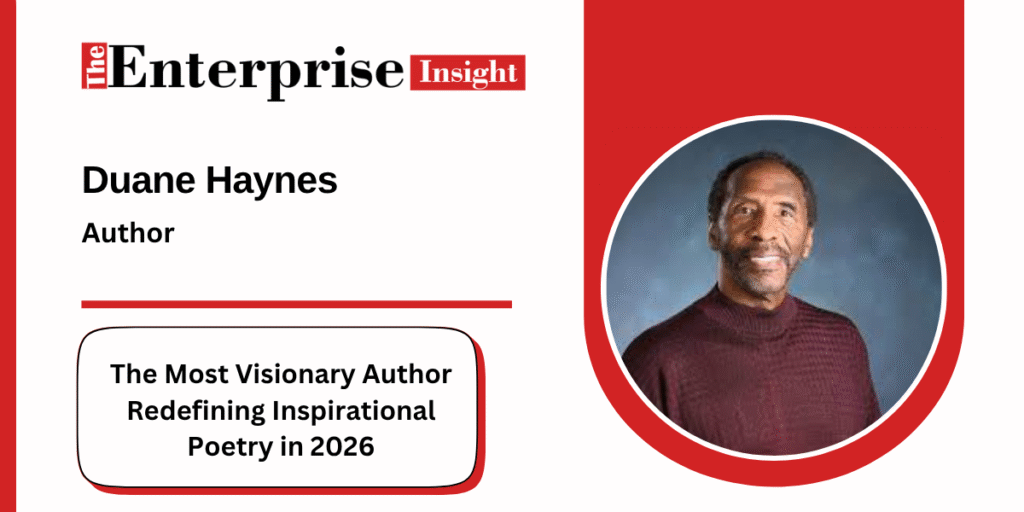
“I don’t consider my poems and pairables a message but a gift from God to help readers find their pathway to realizing their purpose in life and the way home.” — Duane Haynes That is how Duane Haynes speaks about his work. Not as something he created. But as something he was given.He is not a typical poet. He does not sit in coffee shops with a notebook, waiting for inspiration to strike. He does not follow writing prompts or attend workshops on craft. His process is different. Stranger, maybe. But for the millions of people who have read his work, it is undeniably real. Haynes is the author of To Flourish: God is the Light, We are its Spectrum. The book has been nominated for two global awards: Best Nonfiction Poetry Book in the World and Best Nonfiction Inspirational Poetry Book in the World. It has over 1,119,317 five-star reviews on Trustpilot, where it is also labeled “Most Popular Book.” But the story of how this book came to be begins decades earlier. And it begins with a fall. The Coma That Changed Everything Duane Haynes was born in Denver, Colorado. Duane Haynes was born ten minutes after his identical twin brother Darrell. He has two brothers and one sister in addition to his elder brother. The house was full of people. His childhood years were filled with energetic activities. The world came to an end for him when he reached twelve years old. Haynes suffered a dangerous accident which resulted in his death. He remained unconscious for a period of three days. The boy who had closed his eyes began to experience life again when he opened his eyes. Haynes says he has a complete memory of everything that happened during the three-day period. He says he was shown Heaven. He says he encountered God. “God showed me all of Heaven and Love,” Haynes recalls. “He then told me what I must do, and gave me a gift and said, ‘Go back into the world and give them this gift, tell them so that they can find their pathway to the way home.’” For about two months after waking, Haynes did not write. He did not speak much about what he had seen. But then something shifted. Late at night, he would wake up suddenly. He would write a poem. Then he would go back to sleep. The poems confounded everyone who knew him. The insight. The depth. For a twelve-year-old, it seemed impossible. Some called the poems prophecies. Others called them insights. Haynes simply called it sharing his gift. How the Poems Actually Get Written Decades later, the process has not changed. Haynes does not sit down at a desk and decide to write. He does not plan a theme or a collection. Instead, he sleeps. Late at night, he wakes up. He writes a poem. He goes back to sleep. But there is another layer to this process that makes Haynes unique. “Each poem was written to be given to someone to answer their prayers and to guide them during their trials and tribulations,” he explains. “God instructs me to put the poem in an envelope and later he tells me who to give the poem to when that person is put in my path.” Think about that. A poem is written. It goes into an envelope. Days or weeks pass. Then, according to Haynes, God places a specific person in his path. And that person receives the poem. What happens next? Haynes says each person knows, in some way, that this was supposed to happen. They accept the poem with anticipation. “It’s like they knew,” he says quietly. That is not a marketing strategy. That is not a gimmick to sell books. That is, Haynes says, simply obedience. The book To Flourish: God is the Light, We are its Spectrum contains all the poems which I wrote throughout my life for different people. The book is available worldwide in English, French, and Spanish. The book is available to readers in three formats: paperback, eBook, and audio book. There is even a downloadable album called To Flourish. It is sold on Amazon.com, Goodread,, and through his website at www.TOFLOURISHDH.COM. Not Just a Poet — A Prophet People who know Haynes’s work often use a specific word to describe him: prophetic. In an interview, he was asked what this means in relation to his mission. His answer was direct. “Writing my poems and completing my part by giving them to the person that it was intended for remembering what God told me,” he said. “‘Go back to the world and tell them, so that they can find their pathway to the way home.’ The poet dedicated each poem to the person whom he believed God had brought into his life path according to his understanding of divine will. Haynes does not claim to predict the future in the way people usually think of prophecy. He uses his role as a guide to help people identify their existing vision problems. People need to view themselves through God’s perspective. They should discover their actual purpose which they currently perceive as their only source of suffering. People need to discover their actual route back home which the world presents to them as complete dead ends. He holds a BA in Technical Writing from Metropolitan State College in Denver. That is a practical degree. But his life’s work has taken him far beyond technical writing. He has been interviewed by Ric Bratton, Susan Sherayko, Dr. Angela Chester, and Logan Crawford on the Spotlight Network TV. His work has been featured at the LA Times Book Festival in 2022, the Frankfurt Book Fair in 2022, the Sharjah Book Fair in 2022, the London Book Fair 2026 and the Los Angeles Times Book Fair for 2026. . He is also an ordained and anointed prophet and poet. Those are not self-given titles. They come from a lifetime of recognized spiritual work. The
From Silent Child to Visionary Voice – Award-Winning Author – K. M. Selvidge on Reshaping Mental Health Awareness
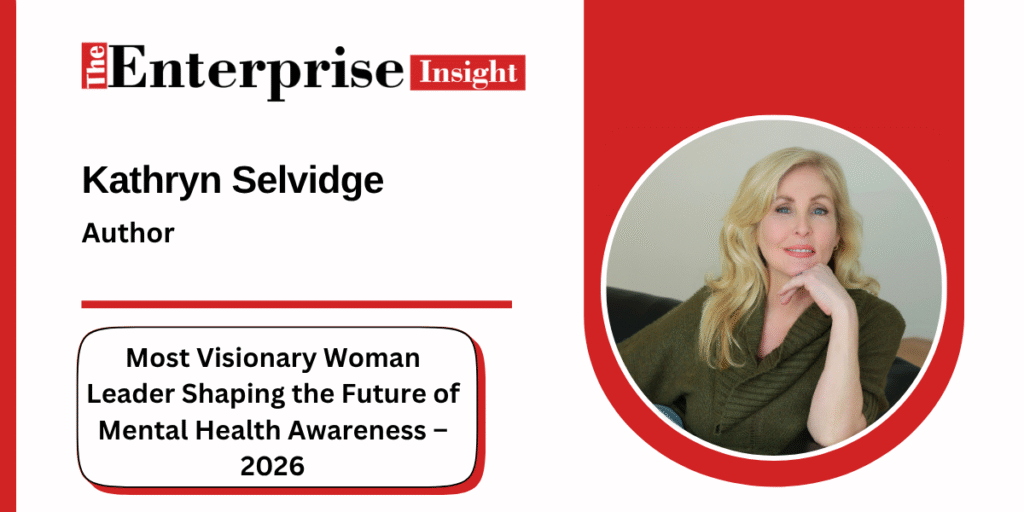
“If I could sit beside my younger self during those turbulent family moments, I’d want her to know that the ache she feels—the confusion, the sense of responsibility, the loneliness—is real and deserving of kindness.” This is the profound advice K. M. Selvidge offers not just to her childhood self, but to the millions of children currently growing up in the shadow of a family member’s mental illness. Selvidge possesses a deep understanding of hidden mental health issues because she has personal experience as the sibling of a brother with mental health problems. Today, she is celebrated as the Most Visionary Woman Leader Shaping the Future of Mental Health Awareness – 2026, a title that transforms personal pain into public action. Through her semi-autobiographical Kloe book series and her nonprofit fundraising background in corporate social responsibility (CSR) and nonprofit development, Selvidge is building bridges where silence once stood. She works to achieve her objective of helping every child who experiences mental health challenges from a family member to feel safe and recognized. This is her story of resilience, compassion, and a lifelong commitment to changing the narrative for the next generation. The Crucible of Childhood – Growing Up in the Shadow of Mental Illness K. M. Selvidge experienced her entire childhood with constant uncertainty, which created an ongoing background noise of doubt. Her brother’s mental illness created an unstable environment because any day could turn from peaceful times into sudden emotional breakdowns. As a child she experienced a struggle between her strong wish to assist others and her complete inability to understand how to provide help. The outside world remained unaware of her situation, which made her isolation even worse because her teachers and friends lacked the ability to observe her family’s hidden turmoil. She needed to protect herself from contact with others because she experienced a complete lack of visibility, which resulted in her brother’s needs taking priority over her own requirements. The process of confusion that she experienced became the place where her inner strength developed. She developed a deep, nearly automatic ability to understand other children who shared her burdens. The heavy burden of wanting to help others through unspoken duties, which she carried from her youth, became the force that led her to succeed. The experience generated a mission for her life that would make her a voice for her invisible siblings in addition to establishing a home-based compassionate education system that reaches all schools. From Stage Lights to Systemic Change – A Career Evolution Before she became a mental health advocate, Selvidge built her career through acting and dancing, which used performance to convey stories. A powerful transformation brought her to nonprofit development and corporate social responsibility (CSR) work, which became vital for her present professional duties. Through her work in CSR, she acquired skills to create strategic alliances that would deliver measurable results while connecting with various stakeholders. She helped organizations like the Columbia Law School, the YMCA, and the Juvenile Diabetes Research Foundation exceed ambitious goals, gaining a results-driven mindset that now fuels her advocacy. Through CSR she learned to start with listening and then explain complex human problems in simple terms while creating effective solutions for different environments. Selvidge uses her combined abilities from artistic creative work and strategic business planning to develop systems that create hope. She knows that children need both emotional stories and systematic partnerships together with precise performance evaluation to achieve lasting improvements in their mental health. Kloe’s Voice, K. M.’s Heart – A Story Carried for 30 Years K.M. Selvidge maintained silence about her childhood story for more than three decades. The decision to finally write Kloe’s New Start and Kloe’s New Friendship came when she recognized a rare alignment: a growing societal openness about mental health and an urgent, persistent need for authentic representation. She observed that educational institutions and family environments showed increasing dedication to mental health discussions, yet they still failed to acknowledge the circumstances that affected siblings who cared for their mentally ill brothers and sisters. She told her story because she wanted both to demonstrate her resilience and to create a teaching advantage. Selvidge uses her experience of feeling invisible to create Kloe’s journey, which helps young readers understand their own struggles while learning to develop hope and inner strength. She understood that a semi-autobiographical approach would deliver actual life experiences. She required more than simple guidance because she needed to provide people with her personal insights. Children discover their own internal struggles when they read about how Kloe shows her various emotions of uncertainty and love and fear while they discover their own personal existence. Why Animal Characters? The Gentle Power of Creative Distance Selvidge made her most original artistic choice through her decision to present Kloe’s story through animal characters. The idea exists as a psychological mechanism that people use for specific purposes beyond playful fun. The presence of animal characters creates a soft resemblance that enables young readers to understand family mental illness through direct experience without entering dangerous emotional boundaries. A child who might feel too vulnerable or ashamed to discuss a parent’s or sibling’s breakdown can safely project those feelings onto a character like Kloe the cat. The method provides a creative area where people can work through complex family situations that involve unpredictable behavior, emotional terror, and feelings of guilt and love. The story gains worldwide appeal through its animal characters. All children, regardless of their racial background and religious beliefs and home diagnostic assessments, can engage with the story. The themes of resilience, empathy, and hope become accessible to all. Selvidge understands that people need to take their first step toward healing through a non-threatening situation, which her animal characters provide as a gentle introduction to challenging yet essential talks. A Message of Validation for Children and Parents Alike The Kloe series’ main message, which Selvidge wants to share with readers, represents her response to the fundamental struggles that families endure. She wants children—and their parents—to understand that people experience overwhelming feelings
The Art of Living Intentionally: A Conversation with Maria Castellucci Moore
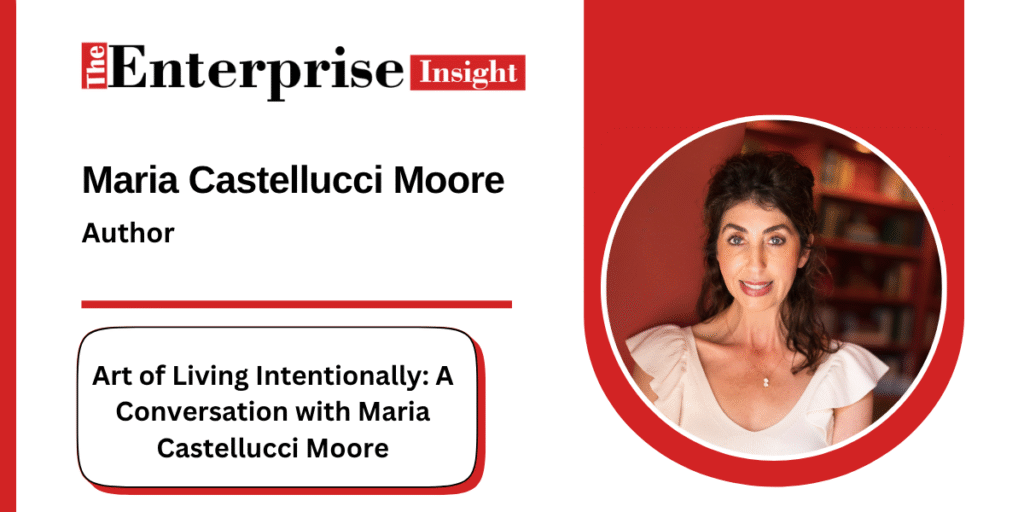
“When you move through life with intention, patience, curiosity, and heart—whether holding a book or a glass—you create experiences that nourish, connect, and endure.” The words of Maria Castellucci Moore demonstrate her identity as a woman who developed two different but beautifully connected professional paths based on her personal philosophy. Maria Castellucci operates Castellucci Estate at Carneros in Napa Valley while she holds the title of first-generation Italian American and award-winning author of the Traveling Mindfulness Series for children. Her journey shows deep connections to the land and her family and her creative work and her connections with her local community. Maria moves through different realms by using her family-owned land to farm Pinot Noir, which reminds her of her father’s Calabrian childhood, and she writes children’s books that teach mindfulness through the experiences of her four children. She produces single-vineyard wines that bear Italian musical terms as names, while she backs arts education, and she creates narratives that enable young readers to uncover the marvels that surround them. The woman demonstrates her leadership skills through her work in a male-dominated field, which she leads with a focus on long-term impact instead of business expansion, while she works to support other people through her charitable activities and storytelling efforts. Maria describes her most important life events and the principles that guide her work as a writer and winemaker and mother and legacy creator in this rare interview. Roots and Resilience: The Immigrant Story That Started It All The life of Maria Castellucci Moore starts from her father’s family’s annual journey to Calabria’s small villages, where they created wine through their basement wine production. The process of transforming grapes into wine for communal use demonstrated to him that this activity served both economic purposes and the functions of cultural heritage and social bonds and personal identity. The first-generation immigrants of her family brought their ancestral practices to America when her parents arrived as immigrants who sought better opportunities. Her father discovered his ideal house when he found a magnificent estate in the Carneros area of Napa Valley. The land, which produced perfect Pinot Noir and Chardonnay grapes, connected him with his heritage and his boyhood times in Italy. The family’s initial pastime developed into a much larger enterprise, which they built from their original family activity. The vineyard served as Maria’s connection point between her Italian heritage and her American future. She explains that her winemaking practice combined her passion for the land and agriculture with her artistic expression of winemaking. Maria realized that she cultivated social connections through her grape farming operations because she raised her children on the same land, which held historical ties to their ancestors. The ancient tradition of winemaking exists as a timeless artistic expression, which she used to establish a legacy path for her family. The Calabrian origins of her family established their roots in Napa Valley, but they would transform into a splendid achievement. Finding Her Why: The Transformative Power of Purpose The turning point of Maria’s important life journey arrived at the moment when she discovered her fundamental purpose. She discovered her authentic self during a period of personal difficulties, which required her to overcome obstacles. Her deep understanding of herself would become the basis for her winemaking and writing practices. The vineyard operations established a dedication system that prioritized intentional methods over business growth, product excellence over product volume, and narrative development over marketing techniques. “When you find your ‘why,’ it is transformational,” Maria explains. The business foundation established by Castellucci Estate operates as a boutique brand that develops deep connections instead of pursuing business expansion. The organization operates from a core mission, which directs all wine and vintage and decision-making processes. The same knowledge system her children’s books developed from her experience of developing mindfulness skills during personal development. The realization that one person could change another’s life through authentic expression propelled her forward. Maria’s “why” exists as a dynamic force that continuously shapes all her professional activities. The artist needs to create from his inner self because genuine artistic expression will always prevail, according to her. The creator’s purpose becomes transparent through his work, which includes everything from wine to children’s literature. The Philosophy of Place: Crafting Wine That Tells a Story The fundamental principle of Castellucci Estate centers around the belief that wine forms a conversation among the elements of land and time and human beings. Maria describes the estate’s core approach as “rooted in the interconnectedness of family, artistry, and intention.” The wines present themselves as single-vineyard wines that showcase their origin through their dedication to time and their ancestral heritage. The Oakville Castellucci Estate vineyard needs to show itself, which unites its ideal weather conditions and soil features and expert agricultural methods and proven winemaking abilities into one perfect result. “Our brand achieves its highest expression through our land,” Maria states. The commitment to terroir requires vineyard operations to accept that environmental conditions will determine their yearly production capabilities, which depend entirely on natural weather patterns that operate in an unpredictable manner, and thus maintain a state of modest and respectful behavior among team members. The brand reached new heights because Maria hired Philippe Melka, who introduced his team to the winery while maintaining its original European style by using terroir-based methods. Maria describes the wine as “a sensory story meant to be shared” because it goes beyond its function as a beverage. Each bottle holds more than fermented grape juice because it contains the family’s history and the unique characteristics of the land and the goals of everyone who interacted with the product from its vine stage through to its glass stage. Wine functions as a narrative that transforms into a legacy that exists as an artistic expression. Harmony in a Bottle: Where Wine Meets Music and Philanthropy The competitive global market finds its unique selling point through Castellucci Estate’s exceptional combination of wine and music, which holds special significance for Maria and her family.
The Human Algorithm: Ramesh Bairi Merges Tech, Trust, and Wellness
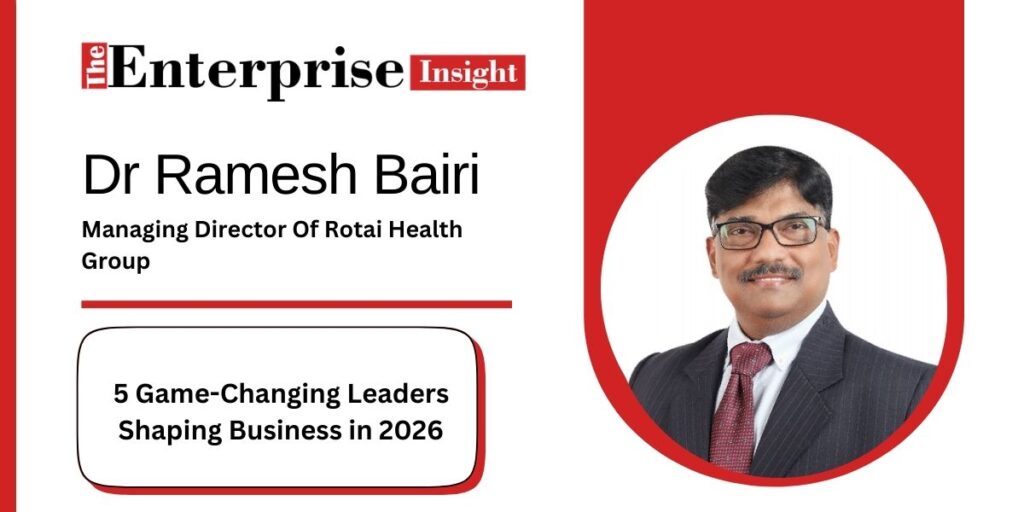
“Leadership is not about being in charge. It is about taking care of those in your charge.” This is not only a quote for Dr. Ramesh Bairi, Managing Director of the industry-leading Rotai Health Group, but also the roadmap of a career that has spanned over three energetic decades. Bairi, in the time when business stories were mostly told in terms of speed and disruptive noise, also speaking of a different, more lasting kind of change: one that is made through global ambition and local compassion, aggressive strategy and humane governance, Bairi being a change-maker who believes that sustainable growth is at the intersection of global ambition and local empathy, and of aggressive strategy and humane governance. As we approach the year 2026, which is going to be the scene of digital intelligence, wellness revolutions, and geopolitical shifts, leaders like Bairi who are not only looking to the next quarter but also the next quarter-century are becoming the defining archetype. His journey from urban sales markets of 1990s India to the director of a forward-looking health-tech conglomerate across international markets is close to a perfect example of both adaptive and principled leadership. This is the tale of how a leader influences a company and how that company’s value system in turn influences the future. The Formative Crucible: Lessons from the Ground Up Ramesh Bairi’s journey into the business world was anything but coming from a boardroom. He was in the thick of it all in the Indian markets of the early 1990s, where his sales and marketing activities took place and where modern retail concepts were still in their adolescence. This experience at the very center of action turned out to be his deadliest weapon in the battle of learning and unlearning. The market was his school and close to the market was his teacher, he says looking back. Here he was able to observe consumers, figure out prices and, most importantly, gain trust with the people he was working with. He made it clear through the immersion that business was a human act by saying that the market was not a thousand but a human. He was not just a brand leader for global brands; first, he was a listener of the market’s heartbeat—a skill that later would make him different from others in hearing the subtle variations of pulse across continents. The Global Pivot: Where Strategy Meets Culture The defining moment that changed Ramesh Bairi’s path was his entrance into international business, where he covered Africa and the Middle East. It was the main reason he admitted to his love for world brand building. He saw that the most powerful brands were like “trust systems,” where they made emotional connections between different countries. He soon realized that the best way to get his message across was to make brands that are “globally credible yet locally relevant.” He would not have a one-size-fits-all model and, instead, he would perceive that it is the collaboration and acknowledgment of indigenous culture which would lead to global consistency and, therefore, the sustainability of the enterprise in the long run. His perception quickly turned into the rule of thumb in his management of the world and he converted the market intricacy from a hindrance into a means of competitive advantage. Leadership Forged in Complexity, Not Comfort Ramesh Bairi does not mince words when he says his leadership was more influenced by the hardships and complexities of the situation rather than by ease. His experience of handling operations in different countries gave him the insight that a really great leader is the one who provides rock-solid clarity and does not put uniform control on every aspect of the operation. He declares, “The execution may differ in different markets, but the three principles of accountability, transparency, and trust will always be the same.” Among the significant happenings were the bottling off of companies with modest revenues and the infusion of nine-digit turnover, a journey that called for the establishment of tough systems and the very hard practice of turning down unsustainable growth. This was all going on at the same time as other economic downturns and very important negotiations, which made him even more resilient and taught him even more about the critical role of emotional intelligence and humane decision-making during pressure times. The Core Lesson: Governance Over Mere Growth For Dr. Bairi, the major career lesson that he concludes with is the same as the basic rule: “Growth without governance is fragile.”He warns the leaders against the costly mistake of using temporary market lift and permanent supremacy interchangeably. The true and lasting success, he asserts, is not a fortunate occurrence of events but the intended result of a stringent alignment of the four pillars; a coherent strategy, capable people, robust processes, and unwavering core values. This structural necessity is accompanied by an equally strong personal conviction: “Leadership is a responsibility, not a privilege.” According to him, a leader’s lasting impact is determined not by their rank or title, but by their visible actions—the calmness exhibited during a crisis, the kindness shown to the team in hard times, and the daily adherence to the proclaimed values. These two aspects combined form the ethical foundation of his philosophy. It argues that to create a lasting institution, both the architectural discipline of proper governance and the moral discipline of accountable, values-driven conduct that ensures scaling is done on a non-crumbling base need to be combined. Rotai Group: Innovation with Empathy Dr. Ramesh Bairi’s leadership has been most instrumental in shaping the Rotai Group into a company that stands out for its melding of high-tech with human wisdom. He describes the company’s nature as “an organization centered on the future, health, and technology that is devoted to a better life through smart wellness solutions.” This vision has very little in common with mere commercial transactions; it is, rather, a promising lifestyle change in which advanced technology will play a very human role. The idea of “innovation with
James Stephens: The Man Who Bet on Quantum Before the World Knew It
The lab is not the only place where true innovation occurs, sometimes it even happens among personal crises. For James Stephens, the future of digital security was determined by personal loss – the pain of crypto scams that had trust issues as collateral damage plus the cancer battle that allowed him to define resilience. He was the only one who saw a blueprint while others were caught up in setbacks. This mixture of human and technological weakness made him draw a very radical conclusion that the next big thing in the digital world is not just to build faster blockchains but to build ones that cannot be broken. This is the belief that underlines Krown Network and makes James Stephens more than just a CEO; he becomes a trust architect for a quantum world that is yet to arrive. His trail blazed through time and was not in vain; he changed the future from visions into code for an ecosystem strong enough to survive the hazards of tomorrow through personal hardship. This is the narrative of the person who is a pioneer of the incorrigible spine of our digital future, a person who works years ahead of the rest of the world, hearing the clock ticking only when it is too late. Leadership Tempered in the Crucible of Challenge Stephens’ trajectory was never a straightforward climb. One of his biggest professional obstacles was the lonely battle at the beginning to persuade skeptics that quantum security was an urgent need rather than a fancy word, an issue far away in time. James Stephens’s warnings about the future threat from quantum computers in the area of security were oftentimes dismissed as being premature or unnecessary in an industry that was usually concerned with immediate scalability or speculative yield. Alongside this professional disbelief was a very personal struggle: he went through cancer three times. These two-fold trials—one of foresight and the other of life—were the major factors that changed his concept of a leader. They were telling him that a leader is only defined by his challenges, but rather by the character and strength shown when responding to them. The ability to listen with humbleness, the openness that comes from being vulnerable, and the unwavering strength necessary to push through hard times became the fundamental principles of his leadership style, which was directly forged in these trying fires and is still now embedded in Krown’s operational DNA. The Foundational Learning: Adversity as the Ultimate Teacher Upon reflecting on his travel, Stephen simplifies his major lesson into a strong saying: failure and hardship are teachers not sentences. Every case of skepticism in the profession and every personal loss did not act as a stop sign but as an agent that made him stronger, thus his determination was made stronger and his method was improved. This acquiring of knowledge has a major effect on his leadership style that puts listening, integrity, and people-centeredness at the top in every decision. At Krown Network, such changes lead to an organizational commitment to transparency and accountability being a part of the company’s culture. Publicly declared roadmaps that the company is determined to meet, in periodic “Ask Me Anything” sessions that keep open communication with the community, and in compensation systems that are favorable to long-term holders rather than short-term traders are some of the ways this manifests. For Stephens, this principle is the absolute foundation of sustainable growth, always reminding us that technology should ultimately be for the people and not against them. Solving the Dual Crisis: Security and Utility Krown Network tackles head-on two major problems that have been around in the blockchain industry for a long time. To begin with, it deals with the issue of quantum threat which can end the existence of the major blockchains by attacking the very cryptographic methods that are used today. The team composed of Stephens and others has already made sure that the Krown platform will be automatically secured against quantum attacks by integrating the use of Quantum Random Number Generation from their collaborators QeM and Post-Quantum Cryptography from ExeQuantum in addition to their patented PQC protocols. Next, it tries to solve the widespread “utility gap” problem where most projects are reduced just to the speculation of tokens. Krown’s extensive Camelot Ecosystem is the concrete example of the coming of Krown, which is capable of all that and even more—facilitating payments and socializing, sophisticated trading, and asset tokenization—just to name a few. Krown’s security combined with its vast utility is very much like an all-in-one digital economy instead of just a single-point solution like with others. The Proprietary Edge: Frameworks for an Unbreakable Future To realize this vision, James Stephens and his team have developed groundbreaking proprietary frameworks. The most user-facing is 4FSA (Four Factor Synchronous Authentication), a login system that seamlessly layers facial recognition, fingerprint, voice, and a secret phrase—all within five seconds—creating arguably the most secure wallet and ecosystem access in Web3. Beyond partnerships, they have also developed their own proprietary Post-Quantum Cryptography (PQC) frameworks, establishing valuable intellectual property in next-generation blockchain defense.From an architectural point of view, the whole project is ruled by the Camelot Ecosystem model, a connected economy comprising more than thirty utilities where each of them adds up to the value of the native KROWN coin. Such advancements not only make Krown different but also incredibly hard to copy thus establishing a strong barrier for competition. Thought Leadership: Mentoring the Next Generation – James Stephens Stephens does not only influence through Krown’s codebase; James Stephens has been doing so by being a leader and a mentor. He was a writer of research and book material covering various aspects of security such as quantum and blockchain, being one of the major contributors and has been talking on the panels where AI, blockchain, and quantum computing were the topics of discussion. He was perhaps the most impactful, as he was the one who provided support and guidance to the new entrepreneurs in the Web3
Building a Legacy of Truth: The Dan Wolstein Story
“What lies ahead of you and what lies behind you are tiny matters compared to what lies within you.” This powerful philosophy is the basis of the revolutionary method of legal expert services of Dan Wolstein. In the high-risk arena of evidentiary hearings, wherein expert witnesses are likely to sway the verdict of cases worth multi-millions, Wolstein has developed a profitable practice and also an alternate model that gives precedence to human capability and moral leadership. Through the faith in inner power, Wolstein has maneuvered Kincaid Wolstein into the group of roughly 25 professionals who are setting the new standards for being the experts in today’s intricate and difficult legal situations. The Foundation: Mentorship and Mastery Dan Wolstein’s career path leading to vocational and rehabilitation services was initially determined by his stepfather, Dr. Charles Kincaid. At the same time, he was under the supervision of Dr. Kincaid; he learned vocational evaluation and life care planning aspects thoroughly. He says, “He started me at the bottom of the company, and I progressed all the way up to the top as a testifying expert.” This training reinforced the necessity of meticulous analysis and the capacity to convey the conclusions clearly in court. Wolstein’s early period was a great learning experience, as he was able to witness the scientific and practical sides of vocational expertise. By watching his mentor’s savvy in the courtroom—direct examination and challenging cross-examinations—he got a glimpse of the field. This base not only imparted him with technical expertise but also lit his fire to assist people to live through vocational rehabilitation. The Vision: Building Beyond Tradition When Dr. Kincaid retired in 2018, Wolstein was at a turning point. Instead of just keeping things as they were, he dreamed of the firm significantly increasing its influence and power. “I was driven to strengthen the firm,” stated Dan Wolstein, which in turn impressed his ambition of instituting a distinct entity in the vocational and rehabilitation services sector. His aim was to grow while at the same time providing the same personalized, boutique-quality service that had been the hallmark of the firm. Wolstein’s plan was to increase the firm’s know-how by adding to it and enlarging the team. “I am indeed very motivated to find out how far the firm can go and how many experts we can have in the different specialties,” he clarifies. Presently, Kincaid Wolstein Vocational and Rehabilitation Services has a staff of about 25 specialists who are all focused on and committed to creating and nurturing a field of excellence and innovation. The Strategy: Accessible Expertise Kincaid Wolstein, an expert firm, aimed at being different from the established experts; hence, the need for a unique strategy. The main reason for their coming was really their strong belief in service and being prompt. “We found our way by being extremely responsive and also collaborating as a team under the pressure to turn reports around in tight deadlines,” Wolstein narrates. This working strategy became the hallmark of their success, proving that reliability and cooperation could even beat the established market positions. The multi-specialty structure of this expert firm also gave them a competitive edge. “As for Kincaid Wolstein, the experts’ help is always available,” points out Wolstein. “We possess a lot of professionals working in different fields and thus make it easier for our clients to get all needed services under one roof.” Such a manner of working, partnered with what Wolstein terms as experts who “testify very well and are very good with cross-examination,” gave the attorneys involved in intricate litigation cases that needed a variety of skills dealing with them amazing value. The Culture: Principles Over Rules Dan Wolstein’s management approach is a breath of fresh air that is not similar to conventional corporate leadership styles. “He is really the essence of his practice-based, principle-led philosophy,” one can quote him saying, “principles over rules, and always be ready to carry the heaviest part.” Wolstein, instead of managing from the shadows, is right next to his subordinates on the floor and is to “find the best in each member,” and by that, he is to believe that true potential is going to come out from within and not by enforcing it through outsiders. The leading manner brings a great deal of compassion and cooperation in the workplace. “Most people will be easier to handle if one considers and acknowledges them as doing their best work and at the same time takes a solution-oriented approach to guide the poorly offered support through the most effective teamwork,” Wolstein sees this as one of the keys to their success. His way of making decisions betrays this spirit of collaboration: “I always try to consult with others and figure out what is going to work best for the team. It is always with the team in mind that I make decisions.” This particular method ensures that there is mutual respect and joint ownership of the results. The Growth: Nurturing Potential Dan Wolstein’s leadership philosophy has a very significant impact on the company when it comes to career development and promotion. “My administrative staff and my specialists are fully aware that there is no glass ceiling at the organization,” Wolstein says with great pleasure. By holding this position, the company is getting a better and more capable staff through regular competition among them, who can see a long-term career and constant growth in the company instead of looking for promotion outside the company. This belief is also seen in practice through the support provided for the staff’s development. “Some of my admin staff are in training to become experts,” Wolstein notes. “Kincaid Wolstein supports the team’s growth and learning by encouraging those to further their education.” The company is providing education for its people and skill development, which increases the value of its biggest asset—the potential in its workforce—and thus, the cycle of talent development and organizational success will continue. The Innovation: Technology and Transformation Technology has been an essential factor that allowed