
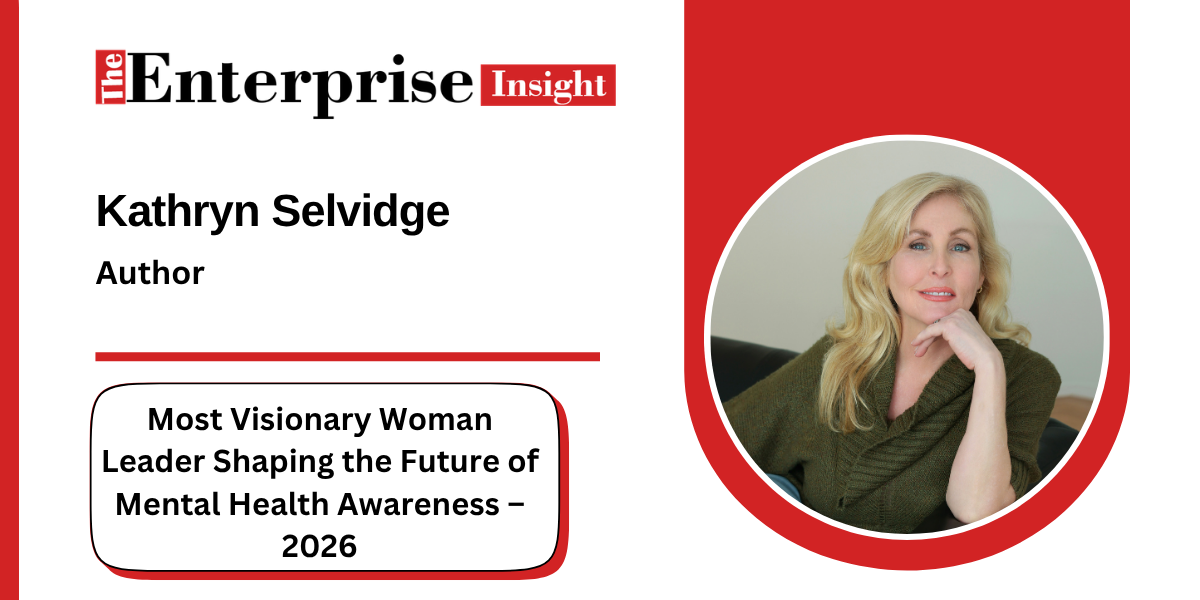
“If I could sit beside my younger self during those turbulent family moments, I’d want her to know that the ache she feels—the confusion, the sense of responsibility, the loneliness—is real and deserving of kindness.” This is the profound advice K. M. Selvidge offers not just to her childhood self, but to the millions of children currently growing up in the shadow of a family member’s mental illness. Selvidge possesses a deep understanding of hidden mental health issues because she has personal experience as the sibling of a brother with mental health problems.
Today, she is celebrated as the Most Visionary Woman Leader Shaping the Future of Mental Health Awareness – 2026, a title that transforms personal pain into public action. Through her semi-autobiographical Kloe book series and her nonprofit fundraising background in corporate social responsibility (CSR) and nonprofit development, Selvidge is building bridges where silence once stood. She works to achieve her objective of helping every child who experiences mental health challenges from a family member to feel safe and recognized. This is her story of resilience, compassion, and a lifelong commitment to changing the narrative for the next generation.
The Crucible of Childhood – Growing Up in the Shadow of Mental Illness
K. M. Selvidge experienced her entire childhood with constant uncertainty, which created an ongoing background noise of doubt. Her brother’s mental illness created an unstable environment because any day could turn from peaceful times into sudden emotional breakdowns. As a child she experienced a struggle between her strong wish to assist others and her complete inability to understand how to provide help.
The outside world remained unaware of her situation, which made her isolation even worse because her teachers and friends lacked the ability to observe her family’s hidden turmoil. She needed to protect herself from contact with others because she experienced a complete lack of visibility, which resulted in her brother’s needs taking priority over her own requirements. The process of confusion that she experienced became the place where her inner strength developed.
She developed a deep, nearly automatic ability to understand other children who shared her burdens. The heavy burden of wanting to help others through unspoken duties, which she carried from her youth, became the force that led her to succeed. The experience generated a mission for her life that would make her a voice for her invisible siblings in addition to establishing a home-based compassionate education system that reaches all schools.
From Stage Lights to Systemic Change – A Career Evolution
Before she became a mental health advocate, Selvidge built her career through acting and dancing, which used performance to convey stories. A powerful transformation brought her to nonprofit development and corporate social responsibility (CSR) work, which became vital for her present professional duties. Through her work in CSR, she acquired skills to create strategic alliances that would deliver measurable results while connecting with various stakeholders. She helped organizations like the Columbia Law School, the YMCA, and the Juvenile Diabetes Research Foundation exceed ambitious goals, gaining a results-driven mindset that now fuels her advocacy.
Through CSR she learned to start with listening and then explain complex human problems in simple terms while creating effective solutions for different environments. Selvidge uses her combined abilities from artistic creative work and strategic business planning to develop systems that create hope. She knows that children need both emotional stories and systematic partnerships together with precise performance evaluation to achieve lasting improvements in their mental health.
Kloe’s Voice, K. M.’s Heart – A Story Carried for 30 Years
K.M. Selvidge maintained silence about her childhood story for more than three decades. The decision to finally write Kloe’s New Start and Kloe’s New Friendship came when she recognized a rare alignment: a growing societal openness about mental health and an urgent, persistent need for authentic representation. She observed that educational institutions and family environments showed increasing dedication to mental health discussions, yet they still failed to acknowledge the circumstances that affected siblings who cared for their mentally ill brothers and sisters. She told her story because she wanted both to demonstrate her resilience and to create a teaching advantage.
Selvidge uses her experience of feeling invisible to create Kloe’s journey, which helps young readers understand their own struggles while learning to develop hope and inner strength. She understood that a semi-autobiographical approach would deliver actual life experiences. She required more than simple guidance because she needed to provide people with her personal insights. Children discover their own internal struggles when they read about how Kloe shows her various emotions of uncertainty and love and fear while they discover their own personal existence.
Why Animal Characters? The Gentle Power of Creative Distance
Selvidge made her most original artistic choice through her decision to present Kloe’s story through animal characters. The idea exists as a psychological mechanism that people use for specific purposes beyond playful fun. The presence of animal characters creates a soft resemblance that enables young readers to understand family mental illness through direct experience without entering dangerous emotional boundaries. A child who might feel too vulnerable or ashamed to discuss a parent’s or sibling’s breakdown can safely project those feelings onto a character like Kloe the cat.
The method provides a creative area where people can work through complex family situations that involve unpredictable behavior, emotional terror, and feelings of guilt and love. The story gains worldwide appeal through its animal characters. All children, regardless of their racial background and religious beliefs and home diagnostic assessments, can engage with the story. The themes of resilience, empathy, and hope become accessible to all. Selvidge understands that people need to take their first step toward healing through a non-threatening situation, which her animal characters provide as a gentle introduction to challenging yet essential talks.
A Message of Validation for Children and Parents Alike
The Kloe series’ main message, which Selvidge wants to share with readers, represents her response to the fundamental struggles that families endure. She wants children—and their parents—to understand that people experience overwhelming feelings that make them invisible while they face challenging situations. The series is designed to give voice to emotions that people typically keep concealed while showing the actual experiences that families believe to be their unique struggle. For children, the message is one of permission: you are allowed to feel confused, angry, or sad, and you are allowed to ask for help.
Through the series, parents receive two tools that help them understand their child better while initiating essential discussions that would otherwise remain unspoken. Selvidge wants all readers to understand that true resilience depends on building human connections instead of enduring hardships without showing feelings. The Kloe series encourages readers to embrace their vulnerability and reach out for help, reminding us that families are never entirely alone during difficult periods.
Normalizing Invisibility – Building Resilience Through Relatability
The needs of many children who have a mentally ill family member are disregarded because their family member needs urgent help. The hidden wound that Selvidge displays through her books requires direct treatment. Kloe’s story normalizes her experience, which enables young readers to understand that their feelings of isolation and responsibility and resentment serve as common human experiences. The series does not provide simple solutions because it creates a secure reading environment where readers can study their strongest emotions which include empathy for sick family members and the normal requirements that healthy children have for assistance.
Selvidge uses her characters to show how people should communicate their needs and seek assistance. When a child sees Kloe talk to a trusted adult or express a difficult feeling, that child internalizes a template for their own actions. The five-star review from Readers’ Favorite, which praised the book for teaching “a lot of new coping skills,” confirms that this approach works. Through her storytelling, Selvidge teaches young people emotional vocabulary and resilience skills that will benefit them throughout their lives.
The Gaps in Our Schools – A Call for Proactive, Not Reactive, Support
Selvidge uses her experience as a former child in crisis together with her present role as a strategic leader to identify important mental health treatment deficiencies that schools use to support their students. The most significant, she argues, is the lack of tailored support for children navigating complex family dynamics. Most school programs take a broad, one-size-fits-all approach to mental health awareness, which results in their failure to understand how siblings and young caregivers experience mental health issues. Schools demonstrate a reactive approach because they provide crisis assistance after a situation becomes critical.
Educational institutions lack systematic programs that would help students learn about their emotions while building resilience skills and developing the ability to express their feelings from an early age. Schools face difficulties because they lack regular access to qualified mental health experts who can provide their services and cultural competency training materials. Selvidge envisions a transformation: mental health education integrated into all aspects of learning, which schools should treat as their daily educational activities. She calls for safe, inclusive environments that protect all children from harm while they develop into adults who need protection until dangerous situations happen.
Redesigning Mental Health Education – A Model for the Nation
Establishing mental health education for schools nationwide requires Selvidge to create a proactive, continuous system that implements inclusive education methods. She envisions educational activities that match students’ developmental stages to become part of daily classroom routines. The program should provide special resources that address the unique requirements of children who come from complex family backgrounds because these resources need to serve as central elements of the program. The curriculum should provide students with chances to share their thoughts together with their classmates through artistic activities, which allow them to express themselves, thus enabling all students to achieve their academic goals.
Districts should standardized access to licensed mental health practitioners who provide culturally appropriate resources, which should not remain as exclusive benefits for districts with higher financial resources. Schools should establish environments in which students understand that mental health holds the same importance as their academic success according to Selvidge’s educational vision. The goal requires multiple objectives because it wants to achieve two results that involve empowering all children to succeed while creating compassion in the community and eliminating stigma before it spreads to young children.
Leadership Rooted in Empathy – Guiding Principles for Lasting Change
The leadership principles of Selvidge, who works as a woman mental health advocate, originate from her personal experiences instead of being theoretical concepts. The organization makes decisions and establishes partnerships and develops its future plans through its core values of empathy together with inclusivity and integrity. Her allies should share her mission to eliminate stigma while they need to be open to learning through their contact with her and others. She asserts that collaboration needs to occur between schools and communities and families and private businesses to establish environments that accept vulnerable individuals without making them feel ashamed.
She wants to create her long-term strategy through continuous mental health engagement because she believes mental health treatment should continue across all stages of life. The private sector needs to stop using short-term awareness campaigns and start establishing lasting programs that include training and curriculum integration and policy advocacy, according to her. Selvidge believes that even the smallest acts of kindness can transform a life. Her leadership demonstrates how compassion works through its gradual and constant power to create spaces that enable all children to feel safe and valued while they develop their potential.
A Message to Her Younger Self – And to Every Silent Child Today
Selvidge reflects on her earlier years by observing her childhood experiences, which included feeling confused, being responsible, and facing social exclusion. She would tell her younger self that her tears and worries showed her strength through her ability to care about others. The child needed to understand that she had people who would listen to her whenever she wanted to share her problems while seeking help. She had to manage her own behavior because she did not own the responsibility to handle any challenges that her brother had to face. Selvidge would tell her younger self to let go of her guilt and while she should prioritize her own needs and aspirations during times when her family faced challenges.
She would first guarantee that her suffering would transform into future optimistic expectations. The hard times of her early life developed her resilience and compassion, which will help her create a meaningful future. The message addresses her earlier life, but it also reaches out to every child who remains silent today. Your existence matters. Your value as a person remains unchanged. Your future holds opportunities for more positive experiences.
A Vision for 2026 and Beyond – The Next Generation Deserves Better
Selvidge is hopeful that the necessary changes for the future will proceed from her stories into 2026. Schools need to establish mental health education as a permanent part of their curriculum because they should not treat it as separate programs. All people should have access to trained professionals who provide culturally appropriate resources, which should not be treated as special privileges. The entire society needs to work together to eliminate stigma, which prevents entire families from speaking out because public awareness campaigns will not achieve this goal.
Selvidge’s vision will create a world where every child receives proper support because their family background does not matter. She is not waiting for that future to arrive; she is building it, one book, one partnership, and one conversation at a time. Her personal journey from being a quiet, scared sibling to becoming a groundbreaking leader demonstrates that true resilience emerges when people decide to make their suffering into meaningful action. The next generation will receive from K. M. Selvidge two gifts that combine hope and a detailed plan of action through her caring approach. She fully supports them by walking alongside them through their entire journey.
For more information on K. M. Selvidge, please follow her on social media – Kathryn Selvidge.16 – Facebook; Kathryn Selvidge – LinkedIn; @Selvkat – Instagram or check out her website
Digital Magazine: