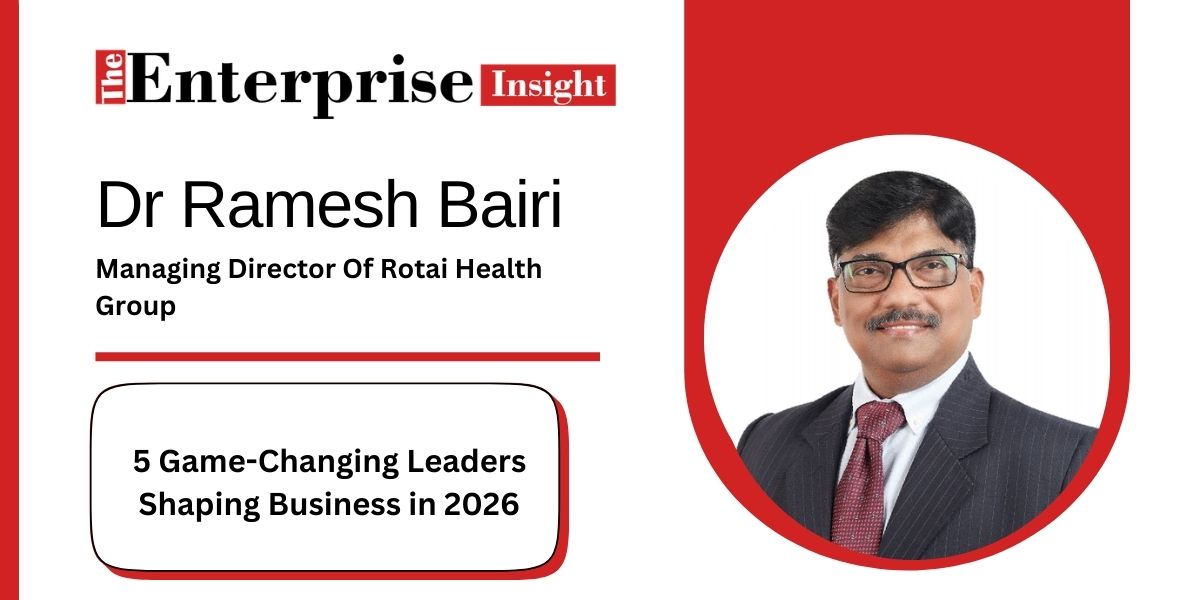
“Leadership is not about being in charge. It is about taking care of those in your charge.” This is not only a quote for Dr. Ramesh Bairi, Managing Director of the industry-leading Rotai Health Group, but also the roadmap of a career that has spanned over three energetic decades. Bairi, in the time when business stories were mostly told in terms of speed and disruptive noise, also speaking of a different, more lasting kind of change: one that is made through global ambition and local compassion, aggressive strategy and humane governance, Bairi being a change-maker who believes that sustainable growth is at the intersection of global ambition and local empathy, and of aggressive strategy and humane governance.
As we approach the year 2026, which is going to be the scene of digital intelligence, wellness revolutions, and geopolitical shifts, leaders like Bairi who are not only looking to the next quarter but also the next quarter-century are becoming the defining archetype. His journey from urban sales markets of 1990s India to the director of a forward-looking health-tech conglomerate across international markets is close to a perfect example of both adaptive and principled leadership. This is the tale of how a leader influences a company and how that company’s value system in turn influences the future.
The Formative Crucible: Lessons from the Ground Up
Ramesh Bairi’s journey into the business world was anything but coming from a boardroom. He was in the thick of it all in the Indian markets of the early 1990s, where his sales and marketing activities took place and where modern retail concepts were still in their adolescence. This experience at the very center of action turned out to be his deadliest weapon in the battle of learning and unlearning. The market was his school and close to the market was his teacher, he says looking back.
Here he was able to observe consumers, figure out prices and, most importantly, gain trust with the people he was working with. He made it clear through the immersion that business was a human act by saying that the market was not a thousand but a human. He was not just a brand leader for global brands; first, he was a listener of the market’s heartbeat—a skill that later would make him different from others in hearing the subtle variations of pulse across continents.
The Global Pivot: Where Strategy Meets Culture
The defining moment that changed Ramesh Bairi’s path was his entrance into international business, where he covered Africa and the Middle East. It was the main reason he admitted to his love for world brand building. He saw that the most powerful brands were like “trust systems,” where they made emotional connections between different countries. He soon realized that the best way to get his message across was to make brands that are “globally credible yet locally relevant.”
He would not have a one-size-fits-all model and, instead, he would perceive that it is the collaboration and acknowledgment of indigenous culture which would lead to global consistency and, therefore, the sustainability of the enterprise in the long run. His perception quickly turned into the rule of thumb in his management of the world and he converted the market intricacy from a hindrance into a means of competitive advantage.
Leadership Forged in Complexity, Not Comfort
Ramesh Bairi does not mince words when he says his leadership was more influenced by the hardships and complexities of the situation rather than by ease. His experience of handling operations in different countries gave him the insight that a really great leader is the one who provides rock-solid clarity and does not put uniform control on every aspect of the operation. He declares, “The execution may differ in different markets, but the three principles of accountability, transparency, and trust will always be the same.”
Among the significant happenings were the bottling off of companies with modest revenues and the infusion of nine-digit turnover, a journey that called for the establishment of tough systems and the very hard practice of turning down unsustainable growth. This was all going on at the same time as other economic downturns and very important negotiations, which made him even more resilient and taught him even more about the critical role of emotional intelligence and humane decision-making during pressure times.
The Core Lesson: Governance Over Mere Growth
For Dr. Bairi, the major career lesson that he concludes with is the same as the basic rule: “Growth without governance is fragile.”He warns the leaders against the costly mistake of using temporary market lift and permanent supremacy interchangeably. The true and lasting success, he asserts, is not a fortunate occurrence of events but the intended result of a stringent alignment of the four pillars; a coherent strategy, capable people, robust processes, and unwavering core values.
This structural necessity is accompanied by an equally strong personal conviction: “Leadership is a responsibility, not a privilege.” According to him, a leader’s lasting impact is determined not by their rank or title, but by their visible actions—the calmness exhibited during a crisis, the kindness shown to the team in hard times, and the daily adherence to the proclaimed values. These two aspects combined form the ethical foundation of his philosophy. It argues that to create a lasting institution, both the architectural discipline of proper governance and the moral discipline of accountable, values-driven conduct that ensures scaling is done on a non-crumbling base need to be combined.
Rotai Group: Innovation with Empathy
Dr. Ramesh Bairi’s leadership has been most instrumental in shaping the Rotai Group into a company that stands out for its melding of high-tech with human wisdom. He describes the company’s nature as “an organization centered on the future, health, and technology that is devoted to a better life through smart wellness solutions.” This vision has very little in common with mere commercial transactions; it is, rather, a promising lifestyle change in which advanced technology will play a very human role. The idea of “innovation with empathy” was the slogan that best reflected this corporate culture; hence, it was guaranteeing that all products and policies would always be right at the heart of tech, smart design, and real human need.
For Rotai, units are not the only one that measures success, but also the quality of life improved. This way of thinking takes the company to the frontline of the personalized wellness revolution where it is constructing intelligent systems that will adjust to each individual life instead of making users conform to inflexible technology. Being in the forefront of empathetic innovation, Rotai is already a trusted brand that is not only leading the market but also partners in the health journey of its customers.
Navigating Growth: Building Credibility and Structure
The road leading to Rotai’s scalability was full of both expected and unexpected difficulties. One of the main obstacles was gaining trust in the wellness tech market, which is already very sophisticated and very competitive. Bairi realized that the entry into new markets means not only product availability but also educating the consumers and building experimental trust alongside.
At the same time, he was caught in the typical dilemma of a company at a growth stage: how to combine discipline and agility. “Syncing speed with the structure” was of utmost importance – to create the operational frameworks, the supply chains with resilience, and the compliance rigour without making the innovative spirit that powered the company in the first days extinguished. This practice of balancing the competing principles still occupies a prominent place in his leadership style.
The International Playbook: Partnerships Over Presence
Rotai’s entry to foreign markets was successful mainly because of one strategic decision: choosing to build strong relationships over quick, transactional expansion. Bairi promoted the idea of forming partnerships only with those that had the same business philosophy, consisting of distributors, retailers, and institutions. Understanding the unique consumer behaviour and regulatory landscape of each target market was the company’s early investment that complemented this strategy. The combination of both strategies gave Rotai the ability to customize its marketing plan according to local needs while safeguarding the brand promise with the same level of intensity that was the case before—thus, a scalable and sustainable route to international growth was opened up.
The Leadership Style: Clarity, Participation, and Accountability
The leadership of Dr. Ramesh Bairi relies on a strong triad composed of clarity, participation, and accountability. He describes his method as “strategic, participative, and outcome-driven,” the framework of which starts with an unambiguous vision but purposely gives up ownership of the implementation to his teams. He creates an atmosphere where discussion is not only permitted but he also considers dissent based on data and thus, it is strong enough to bring forth the best strategic ideas coming from the clash of different viewpoints.
But this participatory culture is also strict. Bairi thinks that true empowerment is tightly bound to clear accountability. He cautions that “empowerment without accountability leads to confusion, on the other hand, accountability without sympathy leads to fear.” Thus, his style of leadership is always looking for a vibrant and humane balance. It creates an open and abundant ideas forum where people feel heard and trusted and at the same time making sure that every single team member is aware of his/her duties and is held accountable for the results. This harmony elevates participation from simple consultation to a mighty engine for disciplined execution, where collective intelligence is transformed into measurable outcomes through thoughtful ways.
Cultivating the Ecosystem: Team, Trust, and Continuous Learning
For Ramesh Bairi, proper team motivation begins with mutual respect and the alignment of people’s personal goals and the company’s agenda. He believes that mentoring and up-skilling are pivotal to making the company endure. This approach which puts everybody first is simply the result of a very strong trust belief that business needs this type of currency very much. “Trust is established through consistency—doing what you say, keeping promises, and owning up when things go wrong,” he claims. In order to develop, he integrates learning into everyday processes via reviews and interdepartmental collaboration, showing curiosity and a desire to improve from the top down.
The Responsible Vision: Building an Institution with Purpose
Ramesh Bairi’s vision of Rotai may be considered very forward-thinking as he looks at the company’s future. He not only plans to make it a “globally respected wellness and health-technology brand known for innovation, quality, and customer trust” but also to make it noticeable in the scenario. His priority is on responsible growth and raising up the intelligence of the products.
In the end, he is constructing what he wants to survive, “rooted in governance, sustainability, and purpose.” He forecasts that the future of humanity will run on the triad of digital intelligence, sustainability, and a call for ethical transparency. He goes on to add that in this new reality, companies that will be able to fuse technology with human-centered values will be the ones to prosper.
The Steward’s Legacy
“Legacy is not built by how fast you grow, but by how responsibly you lead while growing.” The personal creed of Dr. Ramesh Bairi very well portrays his participation and that of the game-changing leaders making 2026. Bairi, in a business world where huge scale is often the only consideration, is a very interesting counter-narrative. He has shown that the most radical and meaningful growth is the one expressed through human factors being the main concern in the whole process. His path points out that the future is for the so-called leaders who are stewards—who eventually trust architects, system builders, and talent cultivators.
The influence of this great leader of the Rotai Group is already spreading widely beyond the financial reports, supporting a situation where the success of business and the well-being of the people are not priorities against each other, but rather combined through the synergetic goal of flourishing. Ramesh Bairi, in a way, considers acumen as stewardship: he would rather the ‘market’, the organization, and the societies they have dealings with be made conclusively better than when he stepped in.