
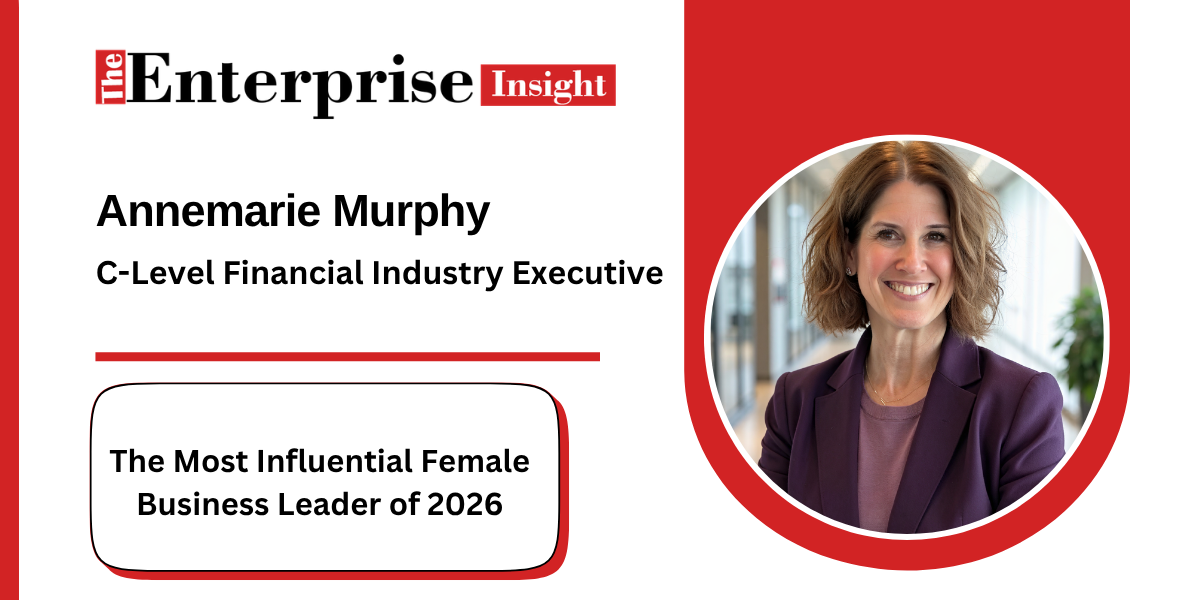
“Do the right thing, especially when no one is watching.”
That simple sentence, offered without theatrical pause or practiced humility, arrives early in our conversation and lingers long after. It is not a slogan framed on a wall at First Bank of the Lake. It is, Annemarie Murphy explains, the quiet metric against which she measures every decision made across a career spanning nearly three decades in government-guaranteed lending. The words carry weight not because they are elegant though they are but because they are lived. When Murphy speaks of integrity, she does not gesture toward compliance audits or regulatory handbooks. She describes instead the unglamorous, high-stakes moments that never appear in annual reports: how you treat a struggling borrower when no examiner is watching, whether you defend an inconvenient position when silence would cost nothing, and how honest you remain in a room where honesty extracts a tangible price.
For Murphy, this conviction is not abstract philosophy. It is inheritance. Her family’s unbroken thread of military service stretches across more than 260 years. Her daughter, brother, and nephew are actively serving today. Her father, husband, and son-in-law have all served previously. That legacy—showing up and doing what is right regardless of recognition, reward, or personal cost—has shaped her leadership in ways both visible and invisible. It is the foundation upon which she built a national SBA lending platform that grew from six people to over two hundred, reached the top fifteen nationally in both SBA 7(a) and 504 lending, and tripled lending to veteran-owned businesses within a single year. And it is why, in 2026, she is being recognized as The Most Influential Female Business Leader of the Year.
From a Small-Business Kitchen Table to the Senate Floor
The origin story of Annemarie Murphy’s career does not begin on Wall Street or in a corporate training program. It begins at her family’s kitchen table, where her father—a small business owner—carried the weight of every payroll, every slow season, every financial decision that felt genuinely consequential. Her mother kept everything else running while her father worked the long hours that come with building something of your own. Murphy watched both of them carefully. What she absorbed was not merely respect for entrepreneurship but an intimate understanding of what a single credit decision actually means: not a line on a memo, but a pressure carried by real people across every part of their lives. That early education shaped something durable in her. She understood before she ever wrote her first loan that lending is not a mechanical exercise. It is an act of professional conviction made under conditions of genuine uncertainty.
That understanding drew her to government-guaranteed lending, a field that exists precisely because strong, capable businesses do not always present in conventional ways. SBA and USDA programs were designed for the complexity that conventional lenders often avoid: the collateral gap, the business at an earlier stage, and the borrower whose credit profile requires interpretation rather than mere calculation. Murphy recognized early that this was not a space you could approximate. The programs have specific structures, eligibility requirements, and compliance obligations that take years to internalize fully. So she did the work. She earned the right to be trusted with complex decisions by developing expertise that was real rather than performed, building judgment that could withstand scrutiny from more seasoned practitioners. That discipline carried her from loan officer to national leader and eventually to testifying before the Senate Small Business Committee in 2022, a turning point that reshaped how she understood her responsibilities.
The Turning Point That Changed Everything
Murphy had not fully anticipated that testifying before the Senate Small Business Committee would become a career-defining moment. She had been doing advocacy work for years—meeting with congressional staff, reviewing proposed legislation, and contributing to industry policy conversations through the National Association of Goverment Guaranteed Lenders (NAGGL). But preparing to testify on the Agency’s proposed rule changes and underserved lending forced her to crystallize arguments in a way nothing else had. She had to translate years of practitioner experience into a clear, defensible case that could hold up under direct examination from a Senate committee. That preparation became its form of leadership development, revealing a dimension of her role she had not fully valued before.
What became unmistakably clear was this: the most durable change in this industry does not only happen at the institution level. It happens at the policy level. The frameworks governing SBA and USDA lending determine which borrowers gain access, under what conditions, and at what cost. And those frameworks respond to serious professional engagement. Once Murphy understood that clearly, she could not define her leadership responsibilities the same way again. From that point forward, she became significantly more intentional about the advocacy dimension of the work—co-chairing the Large Lender & Public Policy Committee at NAGGL, maintaining direct relationships across Congress and the agency, and engaging with proposed rulemaking before it is finalized. Those activities, she explains, are not part of the real work. At this level, they are part of what the real work requires. That expansion of her role accelerated her growth substantially and, she believes, extended her organization’s influence well beyond what its size alone would command.
The Veterans Initiative: Where Mission Meets Bloodline
Ask Murphy what she is proudest of, and she does not lead with the top-fifteen national rankings or the exponential team growth. She leads with the Veterans Initiative. The reason is personal in ways that resist tidy professional summaries. Every generation of her family has served in the military for more than two and a half centuries. Her daughter serves today. Her brother serves today. Her nephew serves today. Her father served. Her husband served. Her son-in-law served. Veterans are not an abstract constituency to Murphy. They are her family. So when she identified a gap in lending activity to veteran-owned businesses, she did not commission a study or form a committee. She designed a targeted program, built the right team, engaged the right partners, and tripled the bank’s lending volume to veterans within the first year.
What made the initiative significant was not merely the volume increase but the ripple effect. Veterans reflect every demographic, every background, every region of this country—rural and urban—every industry, and every community. When you invest in veteran entrepreneurs, Murphy explains, you are not pursuing a niche strategy. You are investing in communities nationwide, all at once. The borrower performance confirmed what her experience already showed: veterans are among the most disciplined, mission-driven, and creditworthy borrowers in the entire portfolio. She was invited to serve on an SBA-led panel during National Small Business Week specifically focused on veteran entrepreneurs, a meaningful platform to advocate for expanding that work further. For Murphy, the Veterans Initiative represents the fullest alignment between who she is and what the work asks of her. It is the place where professional capability meets personal conviction and where both serve something larger than any single institution.
Building a National Platform Without a Central Office
First Bank of the Lake operates differently than most lenders its size, and that difference is deliberate. Murphy built a remote, community-embedded model where team members live and work in the markets they serve. This is not a work-from-home accommodation. It is a strategic conviction. When a loan officer lives in the community where a borrower operates, the quality of decision-making changes. Local industry familiarity, regional economic context, real community relationships—these are insights no centralized operation can fully replicate at the same depth. Murphy understood early that the best intelligence about a borrower’s prospects does not live in a database. It lives in the person who understands why this particular manufacturing business matters to this particular town or why this rural entrepreneur’s supply chain connections are more durable than they appear on paper.
The model required building infrastructure to support it. Technology became the enabler, not the substitute for judgment. Artificial intelligence tools are being adopted deliberately—not to replace the human work of underwriting but to remove the administrative drag that keeps talented people from higher-order thinking. Underwriting research, document processing, and workflow management: these are areas where AI-assisted tools improve speed and consistency, freeing the team to focus on relationship-driven, nuanced work that technology cannot replicate. Murphy applies the same discipline to AI that she applies to credit: clear purpose, rigorous validation, then scale. The result is a national lending platform with over two hundred team members, top-fifteen rankings in both major SBA lending categories, and a culture that remains cohesive without requiring anyone to sit in a cubicle. It is proof that distributed operations, when built thoughtfully, can outperform centralized models at the very things that matter most: judgment, responsiveness, and trust.
Culture Built in Hard Moments, Not Mission Statements
Ask Murphy about company culture, and she will not recite a list of core values or describe an awards program. She will describe instead the moments that are easy to handle poorly. A policy change disrupts a team’s workflow. Outcomes disappoint despite strong effort. The honest assessment is harder to give than the comfortable one. Those are the moments that define what an organization values, far more reliably than any formal document. Murphy tries to lead in those moments with the same standards she applies when things are easy, because she knows that people notice the gap between the two very clearly. A team that receives straight information, delivered with care and context, develops a resilience that a team operating on managed messaging does not.
In a remote organization of over two hundred people spread across the country, keeping the connection to purpose visible and specific requires deliberate effort. Murphy makes that connection concrete. The veteran who just closed a loan to build a business. The small manufacturer in a rural community accessed capital that they could not obtain from any other source. When people understand specifically who they are working for—not abstractly, but through real cases—the quality of effort responds accordingly. Communication patterns matter enormously in this model. The cadence of updates, the honesty about what is changing and why, the willingness to name difficulty directly rather than paper it over—these practices compound over time into either trust or skepticism. Murphy works hard to ensure that her team receives the former. The result is a culture where accountability is not enforced from above but emerges from a shared understanding of what the work is actually for.
Diversity, Equity, and Inclusion as Access to Capital
In Murphy’s leadership framework, DEI has a concrete expression that transcends language borrowed from human resources manuals. The question is not whether an organization has issued a statement of commitment. The question is who has access to capital. Underserved communities, minority-owned businesses, and veterans have historically faced structural barriers to SBA lending. Murphy’s commitment is to measurable outcomes, not aspirational language. The Veterans Initiative is the clearest expression of this philosophy, but it is not the only one. She has built teams where the quality of your thinking matters more than how long you have been in the room, where inclusion strengthens organizational adaptability and thoughtfulness, and where the lending portfolio actively reflects the communities the bank serves.
This approach is not separate from leadership excellence. It is part of it. Murphy observes that inclusion strengthens organizations by making them more adaptive, more thoughtful, and more representative of the communities they serve. A lending institution that does not understand the full range of borrowers it could serve is not merely failing a moral test. It is missing an opportunity. The small business owner with a nontraditional credit history, the rural entrepreneur with limited conventional options, the veteran transitioning from service to civilian business ownership—these are not charity cases. They are disciplined, capable borrowers who have been systematically overlooked. Murphy’s portfolio performance data confirms what her experience always suggested: when you structure credit around real merit rather than surface-level pattern matching, the outcomes are not only equitable. They are profitable.
The Art of Holding the Line While Knowing When to Move
Murphy explains that leadership in a regulated, policy-driven industry is defined by the ability to hold two things simultaneously. The first is the discipline to maintain standards when the pressure to relax them is real and persistent. The second is the flexibility to adapt genuinely when the environment changes, and adaptation is what is called for. Distinguishing between those two situations—knowing when to hold the line and when to move—is the central judgment of executive leadership. Getting it wrong in either direction is costly. Murphy has watched organizations fail by stubbornly clinging to practices that no longer fit the regulatory or market environment, and she has watched others fail by abandoning standards at the first sign of pressure. Neither path leads to durability.
What makes it particularly demanding is the nature of accountability in government guaranteed lending. Murphy is accountable to borrowers, whose access to capital depends on her team’s willingness to understand their situations fully. She is accountable to regulatory and program partners, whose requirements govern how the bank operates. She is accountable to the institution itself, whose long-term health depends on sound credit discipline across thousands of individual decisions. These accountabilities do not always align. Navigating their tension well, without sacrificing any of them unnecessarily, is where leadership is tested most severely. Murphy believes that leaders who treat regulatory frameworks as given rather than as something they can influence are operating with a smaller definition of their role than the work allows. The willingness to engage at the policy level—consistently, seriously, with genuine expertise—is what separates executives who manage within a system from leaders who help shape one.
Advice to Emerging Leaders: Engage Policy Early, Develop Others Generously
The advice Murphy gives most consistently to emerging leaders is counterintuitive. She tells them to develop a substantive relationship with the policy environment earlier than feels necessary and with more seriousness than most bring to it. Government-guaranteed lending is a policy-shaped industry at its foundation. The rules governing who has access, under what conditions, and at what cost are not fixed. They are continuously refined through a process that responds to professional engagement. The lenders who understand that process deeply—who can read a proposed rule, assess its implications for borrowers and institutions, and contribute meaningfully to the discussion—occupy a fundamentally different professional position than those who simply receive the final regulation and adjust. That knowledge compounds significantly over a career, and the relationships built through policy engagement are among the most valuable and durable a leader will develop.
She also encourages emerging leaders to invest in developing others before they feel they have earned the standing to do so. The instinct is to wait—to accumulate enough experience, enough position, enough certainty—before investing in the people around you. Murphy believes that instinct is worth resisting. The earlier you develop the habit of creating opportunity for others, of naming capability in people before they have fully recognized it themselves, the more naturally and generously that becomes part of how you lead at every level. Finally, she advises staying connected to the borrowers you serve—not abstractly but specifically and regularly. The small business owner whose financing you structured. The veteran built something real because capital became available. Those relationships are what keep the work honest. During frustrating periods, when policy moves in the wrong direction or growth becomes harder than it should be, a connection to purpose is what carries you through.
The Legacy That Outlasts Any Individual Tenure
The legacy Murphy cares most about is institutional. She wants the programs, teams, and standards she has helped build to outlast any individual’s tenure, continuing to create opportunity long after the people who built them have moved on. What exists at First Bank of the Lake today—a national SBA lending platform with deep expertise, operational infrastructure, and cultural commitment to serve small business owners at genuine scale—did not exist in its current form a few years ago. Murphy wants that institution to continue growing, improving, and setting the standard for what responsible government-guaranteed lending looks like. If it does, the impact extends far beyond what any individual achievement could reach.
At the policy level, she hopes to have contributed meaningfully to a regulatory environment that is more thoughtful about access—one that reflects the real complexity of small business ownership rather than defaulting to the narrowest definitions of creditworthiness. That kind of contribution is slow, often invisible in the near term, and measured over decades rather than quarters. But it is the kind of change that, when it happens, creates opportunity for people who had no reason to expect it. The most personal part of this legacy remains the veterans her institution has served and will continue to serve. Military service runs through her family across more than two hundred and sixty years, and it runs straight through her household today. That history is the foundation of her conviction that veterans returning to civilian life deserve a financial system that recognizes what they bring. Building a serious, sustained lending commitment around that recognition is the work she is proudest of and the work she most wants to endure.
Conclusion: Purpose and Performance Are Inseparable
Annemarie Murphy does not separate purpose from performance, and she does not understand why any leader would try. In her experience, the organizations that endure are not the ones that are optimized for quarterly returns at the expense of their mission. They are the ones that understood from the beginning that serving borrowers well, including the most systematically underserved, is not a cost of doing business. It is the business. The discipline required to structure credit around real merit, to maintain standards when pressure suggests otherwise, and to show up in policy conversations that shape access for generations—these are not virtues that compete with profitability. They are the conditions that make durable profitability possible.
She hopes she has inspired other leaders to lead with standards that do not bend under pressure, with genuine commitment to the people and communities they serve, and with the belief that purpose and performance are inseparable. If the institutions are stronger, access is broader, standards are higher, and people lead with more integrity because of environments she helped shape, that is the legacy she is working toward. It is not a legacy measured in titles or awards, though those have come. It is measured in borrowers who built something real, veterans who found a financial system that recognized what they bring, and a team that knows—because they have seen it demonstrated consistently—that doing the right thing, especially when no one is watching, is not a slogan. It is the only way to build something that lasts.
For more information on Annemarie Murphy, please follow her on Linkedin or check out her website First Bank of the Lake