
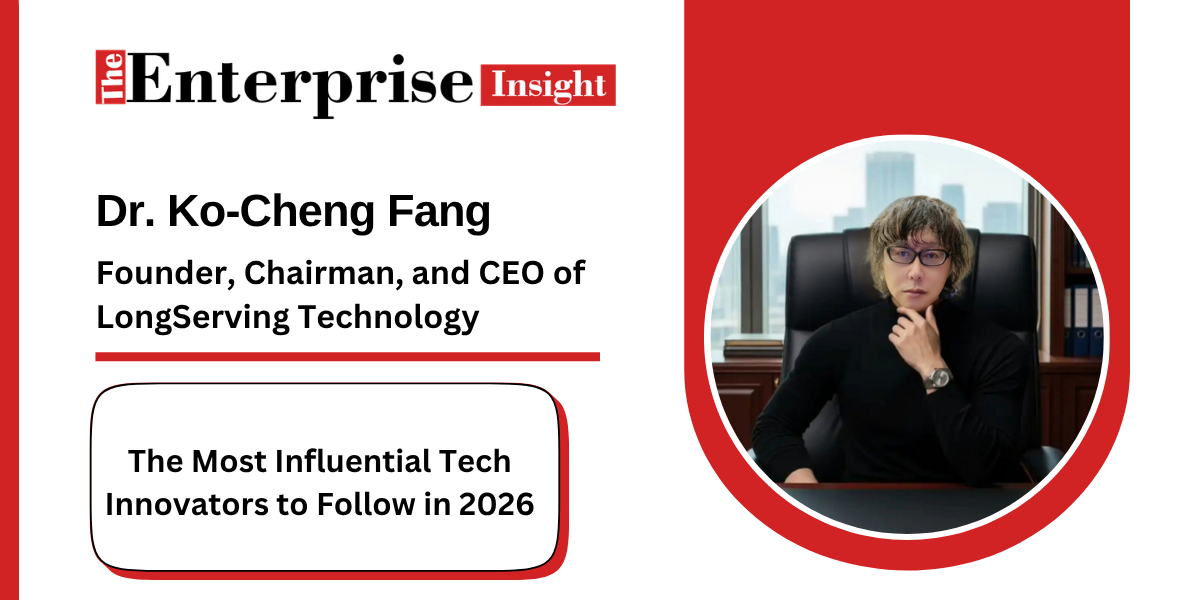
Before Dr. Ko-Cheng Fang was a scientist, he was an artist. Growing up surrounded by sculptures, paintings, and art literature, he developed an extraordinary visual memory and a kind of philosophy where creativity and logic are complementary forces. That artistic discipline—training him to notice details and approach problems with imagination, not just solve them fast—would later become absolutely essential in his scientific work. Today, he stands at the forefront of the photonic revolution and, in a way, bridges art, science, and technology like nobody else has managed before.
That artistic grounding now shows up in breakthroughs that feel like they defy physics itself.
In 2025, Fang unveiled a 2-nanometer X-Photon material capable of confining light and bending it at ninety degrees—something physics declared impossible. For the founder, chairman, and CEO of LongServing Technology, bending light was just the beginning. Between that impossible turn and the promise of a thousandfold leap in computing power lies a journey spanning over two decades—from cybersecurity pioneer to photonics visionary, from U.S. Department of Homeland Security collaborator to the man international media now calls the “Godfather of Photonics.”
The stakes could not be higher. Our insatiable hunger for AI is colliding with the physical limits of silicon. Power grids are buckling. Cooling systems are failing. The “memory wall”—where processors are starved for data by the bottlenecks of copper wiring and electron flow—threatens to halt technological progress. Dr. Fang has spent years developing the solution in relative obscurity. Now, his proprietary X-Photon material and Photonic Memory (PFLASH) architecture are poised to reshape the future of computing, delivering thousandfold speed with ninety percent less energy consumption.
This is the story of how an artist who became a scientist bent light—and in doing so, may just save humanity from itself.
From Cybersecurity to Photonics—A Journey of Vision
Dr. Fang’s journey to the bleeding edge of photonics did not begin in a semiconductor lab. It began, in a way, with art. “Before I was a scientist, I was an artist,” he reflects, kind of like it was obvious. Growing up among sculptures, paintings, and art literature, he built an unusual visual memory and a kind of philosophy where creativity and logic are not really clashing things but instead matching complementary forms of the same curiosity. That artistic discipline—it trained him to notice the small details and to approach problems with imagination, maybe a little stubbornly—later became crucial in his scientific work.
His technological journey formally began in the realm of cybersecurity. Over two decades ago, long before the widespread adoption of smartphones, Dr. Fang proactively developed core technologies such as smart passcode locks and cloud storage, anticipating the vulnerabilities of a connected future. His early patents, including U.S. Patent US 8060933B2, were so foundational that they led to collaboration with the U.S. Department of Homeland Security on decryption and cybersecurity protocols. For years, these inventions were held under strict national security confidentiality orders, a period of enforced silence that Dr. Fang describes as a “setback and self-exile.”
“I don’t focus on tomorrow; I only look back to see if today is better than yesterday,” he quotes, reflecting a philosophy forged by early challenges. “No matter how long the journey ahead, as long as I never give up, success is guaranteed.”
This resilience was tested when he pivoted to tackle what he saw as the single greatest technological challenge of our era: the physical limits of silicon.
Breaking The “Memory Wall”—The Photonic Revolution
The explosion of generative AI and large language models has created a paradox. While software grows exponentially more powerful, the hardware powering it—traditional electronic chips—is hitting hard physical barriers in speed, thermal management, and energy consumption. The industry calls it the “memory wall,” where processors are starved for data by the bottlenecks of copper wiring and electron flow.
Dr. Fang identified this problem years ago and has been developing the solution in relative obscurity until now. “A large-scale cloud computing center requires an enormous memory array,” he explains. “Since photonic computing power exceeds that of electronics by at least one thousand times, a single photonic computing center is equivalent to one thousand electronic computing centers.”
The breakthrough lies in his development of photonic memory, or PFLASH. Unlike conventional systems that constantly convert light to electricity and back again, creating massive energy loss and heat, photonic memory enables the direct storage and transmission of photonic signals. Dr. Fang achieved this through a principle of photochemical energy temporary storage, fabricated into what he calls a “photon capacitance.” Imagine a glow stick that provides illumination without generating heat—that is the basic concept, scaled to a 3D architecture featuring seven laser apertures.
Paired with his X-Photon material, which replaces copper interconnects with optical pathways, the architecture delivers a seismic shift in capability. Traditional silicon chips, even at 2 nanometers, still rely on transistors and copper wiring that are physically larger than the chip’s optical pathways. Dr. Fang’s photonic chips, by contrast, feature a 2-nanometer optical path and photonic gate, eliminating leakage currents and enabling multi-bit (decimal) calculations rather than the binary on/off switching of electrons. The result: a projected 10,000x speed increase over today’s CPUs.
“Seeing traditional electronic chips constrained by physical limits and AI data centers facing severe power grid crises reinforced my commitment,” Dr. Fang states. “This is more than a technical leap—it is a responsibility to society.”
X-Photon Material—The 2-Nanometer Miracle
At the heart of Dr. Fang’s photonic revolution lies the X-Photon material—a proprietary quantum material capable of emitting light at an average wavelength of just 2 to 3 nanometers. To put this in perspective, a human hair is approximately 80,000 nanometers thick. The X-Photon material operates at a scale so small that it challenges the very laws of physics as we understand them.
The material’s development was not a straightforward path. When Dr. Fang sought to advance photonic computing, he found that the domestic R&D environment lacked photonics talent and external partners consistently failed to deliver on time. This drove him to adopt a hands-on “do it all myself” approach—from drawing blueprints and procuring equipment to modifying lithography machines and designing photonic memory architectures.
The material’s true genius lies in its ability to confine and guide light through ninety-degree turns. In traditional optics, light scattering is inevitable; photons cannot be easily bent or contained. Yet the X-Photon material achieves this through its unique transmission properties, enabling optical pathways that are not only smaller than anything previously achieved but also resistant to heat and stable over time.
This breakthrough carries implications far beyond computing. The X-Photon material’s ability to manipulate light at quantum scales opens possibilities in quantum communication, advanced sensors, and even medical imaging. Yet Dr. Fang remains focused on its most immediate application: rescuing AI infrastructure from the brink of energy collapse.
The Strategic Equity Hedging Protocol
Dr. Fang is not merely a scientist; he is a strategic visionary acutely aware that deep tech must enter the market with a plan. To accelerate adoption and commercialization, LongServing Technology has announced a $500 million global strategic financing round at a baseline valuation of $3 billion. Central to this is his introduction of a groundbreaking “Strategic Equity Hedging Protocol.”
Rather than engaging in contentious legal battles with major tech conglomerates who may have historical liabilities related to his foundational patents, Dr. Fang has extended an olive branch. The protocol offers an alternative framework: instead of conflict, companies can collaborate through equity partnerships. It is a sophisticated strategy to convert potential legal friction into powerful alliances, securing manufacturing partnerships with foundry giants and capital from sovereign wealth funds.
“I have chosen forgiveness,” he states. “My message to the global technology industry is simple: rather than remaining divided over the past, companies should join together to build the future.”
This protocol is not merely about avoiding litigation; it represents a new model for deep tech commercialization. By aligning the interests of patent holders, manufacturers, and investors, Dr. Fang is creating a collaborative ecosystem that accelerates the transition from lab to market. His goal is to bring photonic CPUs and photonic memory to mass production within the next few years, driving LongServing Technology toward a Wall Street IPO and the construction of dedicated photonic fabrication plants.
The Polymath’s Canvas—Art, Science, And Jadeite
What makes Dr. Fang’s narrative unique is his refusal to be boxed in. His intellectual canvas extends far beyond computing and cybersecurity. He has successfully pioneered the laboratory creation of Imperial Green jadeite—an impossible feat that required thousands of experiments in geology and chemistry—and in 2026, integrated these gemstones into a luxury handbag collection that merges technology with high fashion.
Chasing lab-grown jadeite isn’t really “a hobby,” more like a kind of lived proof of his cross-disciplinary way of thinking. Making jadeite in a lab means you have to get what’s going on in chemistry and geology, but also how crystals actually take shape, and then the physics side of high-pressure environments. The same sort of mental discipline he uses for photonics shows up again in gemology, and honestly, the outcomes feel pretty breakthrough.
Dr. Fang treats these fields, which look pretty separate at first glance, as if they’re quietly connected. “Science was never separate from art. It became another medium through which creativity could be expressed,” he says, almost like it’s obvious. That view colors how he leads, because he keeps pushing his team to link electronics, materials science, biotechnology, and art, while not getting boxed in by the usual academic boundaries, you know how it goes.
And then there’s the luxury handbag collection, which includes Imperial Green jadeite along with newer photonic materials. It’s planned to launch in the flagship stores in New York and Paris in the future. For him, it’s all part of that idea that technology should be beautiful and reachable, not just functional, but inspiring too.
Leadership In The Photonic Era
At LongServing Technology, Dr. Fang keeps a leadership approach that feels both close-up and cooperative, like he’s in the workshop with everyone but also listening a lot. He will personally draw blueprints, tweak the equipment, and iron out technical bottlenecks when outside partners just don’t come through. Still, he doesn’t really like a hard hierarchy, and he pushes people to question the usual way of doing things, almost like, “Just carry out my directives, and let’s hit our targets.”
“I stress straightforward execution, and I often tell my team, ‘Don’t worry, ask me if something is unclear, and simply execute my directives to achieve our goals,'” he says. “I don’t buy rigid academic boundaries or the usual conventional mindset; instead, I encourage the team to challenge established norms boldly.”
Because of this, the place has grown a culture of self-directed R&D, where innovation isn’t boxed into narrow specialty silos. Team members are encouraged to look past standard textbooks and rule-of-thumb practices and to challenge those technical bottlenecks that seem impossible at first glance.
When resources or specialized talent are scarce, Dr. Fang leads by example with a hands-on experimental spirit—from modifying lithography tools to redesigning chip architectures.
Above all, Dr. Fang holds a strong sense of responsibility toward his employees, aiming to lead them onto the global stage through strategic fundraising and a Wall Street IPO. “I am dedicated to bringing our team onto the global stage through a Wall Street IPO and photonic transformation, ensuring every employee shines while creating meaningful impact for humanity,” he affirms.
The Future—Anti-Gravity, Hoverboards, And Beyond
Looking ahead, Dr. Fang’s vision seems to stretch well beyond computing. He kind of talks about photonic AI robots that are meant to assist healthcare professionals, easing the workload pressure inside hospitals, and then, kind of in the same breath, mentions longer-term research on anti-gravity devices as well as flight hoverboards. He does acknowledge, though, that large-scale validation and regulatory approval are still ahead of us, not something you just “do” quickly. Still, the path looks clear, like a sustained push toward a fully photonic era, where speed feels unlimited, energy use is minimal, and the whole future stays sustainable.
“My long-term vision is to lead the global transition from the ‘Electronic Era’ into a sustainable, unlimited-computing ‘Photonic Era,'” he declares. Addressing the physical limits and energy crises of traditional silicon chips, I am dedicated to deploying our 2-nanometer X-Photon material and photonic memory.”
This vision extends to transportation. Dr. Fang’s research on anti-gravity devices and flight hoverboards is not science fiction; it builds on the same principles of material science and quantum physics that underpin his photonic breakthroughs. While these technologies remain in early stages, they represent the logical extension of his core philosophy: that human civilization must transcend its current physical limitations to achieve sustainable progress.
By integrating photonics, anti-gravity technologies, and lab-grown jadeite, Dr. Fang aims to reshape computing and transportation while safeguarding environmental sustainability. “Long-term, by integrating photonics, anti-gravity technologies, and lab-grown jadeite, I aim to reshape computing and transportation while safeguarding environmental sustainability, propelling human civilization to new heights.”
The Legacy—A Photonic Era For Humanity
As Dr. Fang reflects on his journey, he is getting more and more locked in on the legacy he will leave for future generations—innovators, researchers, and technology leaders who come after. His answer comes out pretty straightforward: a paradigm that dares to push past physical limits and a real benchmark for putting photonics to work for sustainable development.
“The legacy I wish to leave is an innovation paradigm that dares to defy physical limits and a benchmark for applying photonics to sustainable development,” he says. “I hope to show future generations that when they run into seemingly unbreakable bottlenecks, cross-disciplinary thinking together with a hands-on spirit can crack the usual assumptions—like when we managed ninety-degree light bending, and we also built photonic memory.”
All of his life work feels captured in three guiding quotes; they kind of sum up his philosophy, at least in the way he speaks:
“Don’t fear hardship. Without difficulties, there are no sweet fruits. True accomplishment is only earned after enduring setbacks.”
“I don’t focus on tomorrow; I just look back to see if today is better than yesterday. No matter how long the road ahead, I remain on this path. As long as I never give up, success is guaranteed.”
“Do not forfeit your imagination or blindly conform to common wisdom. Reflect continuously: ‘Is this truly so? Is there another road we can take?'”
Through his 2-nanometer X-photon material and photonic computing architecture, Dr. Fang aims to bequeath a green technological foundation featuring thousandfold computing power with minimal energy consumption—inspiring future leaders to boldly construct a photonic era that balances human progress with environmental sustainability.
For Dr. Ko-Cheng Fang, the answer is always yes.
The Man Behind The Breakthrough
Name: Dr. Ko-Cheng Fang
Title: Founder, Chairman, and CEO of LongServing Technology
Education: Cross-disciplinary background spanning electronics, biotechnology, chemistry, and artistic creation
Early Career: Pioneered smart passcode locks, cloud storage, and anti-hacking mechanisms; collaborated with the U.S. Department of Homeland Security on decryption and cybersecurity protocols
Key Patents: U.S. Patent US 8060933B2; multiple global patents for X-Photon material and Photonic Memory (PFLASH)
Notable Achievements:
- Developed 2-nanometer X-Photon quantum material
- Created Photonic Memory (PFLASH) architecture
- Successfully grew Imperial Green jadeite in the laboratory
- Integrated technology with luxury fashion for global markets
Current Initiatives:
- $500M global strategic financing at $3B valuation
- Strategic Equity Hedging Protocol for industry collaboration
- Plans for Wall Street IPO
- Construction of global photonic fabrication plants
Personal Philosophy: “True innovation requires time, unwavering conviction, and continuous investment; it must never be swayed by short-term doubts or market fluctuations.”
Favorite Quote: “Do not forfeit your imagination or blindly conform to common wisdom. Reflect continuously: ‘Is this truly so? Is there another road we can take?'”
Hobbies: Art collecting, basketball, fishing—activities that hone focus and resilience
Long-term Vision: Lead the transition from the Electronic Era to the Photonic Era, achieving thousandfold computing power with ninety percent energy reduction
Quotes That Define Dr. Fang’s Philosophy
On Resilience:
“Don’t fear hardship. Without difficulties, there are no sweet fruits. True accomplishment is only earned after enduring setbacks.”
On Persistence:
“I don’t focus on tomorrow; I only look back to see if today is better than yesterday. No matter how long the journey ahead, I remain on the path. As long as I never give up, success is guaranteed.”
On Imagination:
“Do not forfeit your imagination or blindly conform to common wisdom. Reflect continuously: ‘Is this truly so? Is there another road we can take?'”
On Innovation:
“True innovation requires time, unwavering conviction, and continuous investment; it must never be swayed by short-term doubts or market fluctuations.”
On Collaboration:
“Rather than remaining divided over the past, companies should join together to build the future.”
On Leadership:
“True leadership and innovation are not about chasing short-term trends but about holding long-term conviction, challenging existing frameworks with rigor, and turning the impossible into reality.”
On Legacy:
“I hope to demonstrate to future generations that when faced with seemingly insurmountable bottlenecks, cross-disciplinary thinking and a hands-on spirit can shatter conventional wisdom.”
The Path To Commercialization—Milestones Ahead
2026:
- Integration of Imperial Green jadeite into luxury handbag collection
- Global patent filings for Photonic Memory (PFLASH)
- The company is currently valued at approximately USD 3 billion, with the current valuation primarily based on the R&D achievements and future market potential of our photonic chip and photonic memory technologies.
As the company prepares to enter the next phase of significant technological and product milestones, we are currently planning to release 20% of our limited original equity to qualified investors. This provides eligible investors with an opportunity to participate in the company’s early-stage equity positioning ahead of the next major milestone, while joining us in witnessing the critical transition from technology development to product commercialization and market deployment.
For more information on Dr. Ko-Cheng Fang, check out his website LongServing Technology